Sign up for the Slatest to get the most insightful analysis, criticism, and advice out there, delivered to your inbox daily.
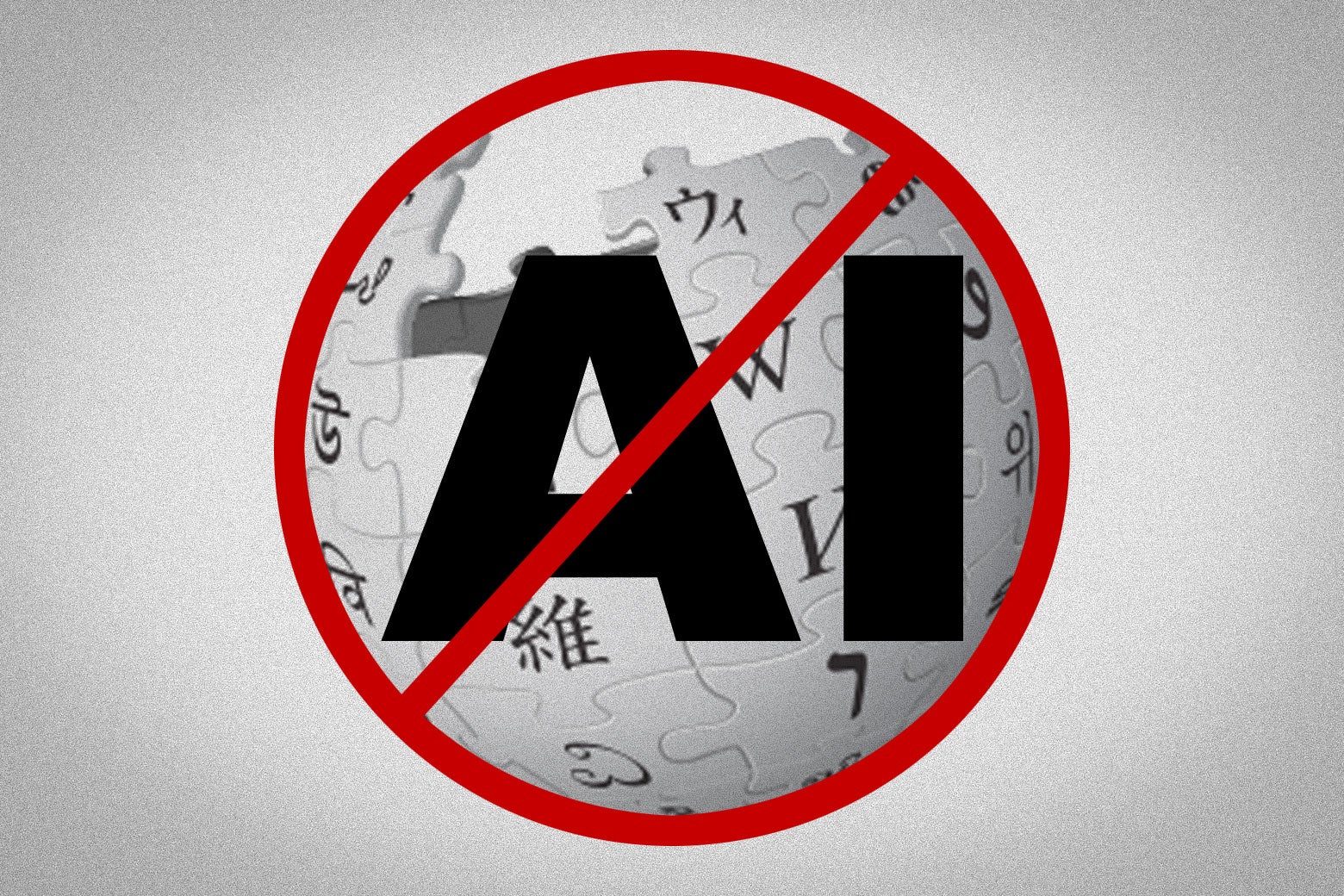
On March 20, volunteer editors for Wikipedia’s English-language platform formally voted to ban all A.I.-generated text from its 7.1 million articles. The new policy erases all previous ambiguity around the question of whether bot-made text can exist on Wikipedia’s public pages: It’s a clear no, although editors are still allowed to use A.I. tools to proofread their writing or translate foreign-language entries.
The decision arrives not a moment too soon for the online encyclopedia, which has seen a deluge of hallucination-prone, autogenerated articles since ChatGPT’s launch. However, the new policy didn’t come without controversy: Wikipedia’s editors argued internally over various use cases for artificial intelligence, including the potential inclusion of now-common internet features like generated article summaries.
Ilyas Lebleu, an A.I. research student based in France who edits Wikipedia under the username Chaotic Enby, first wrote the proposal that was debated and adopted as the site’s A.I. ban. I spoke with them about why this step finally became necessary, why it doesn’t mean the end of all A.I. on Wikipedia, and what other platforms struggling with bot-related spam can learn from the experience. Our conversation has been edited and condensed for clarity.
Nitish Pahwa: How long have you been thinking about how to tackle A.I. across Wikipedia?
Ilyas Lebleu: Around a year after ChatGPT was released, when it was using GPT-3.5, we started seeing a lot of obvious signs: articles with the “This large language model” prompt left in the text, entirely nonexistent citations, and overuse of words like rich cultural heritage. So we decided to create a WikiProject called “AI Cleanup,” where editors would share their tips on how to spot A.I. Then the discussion started to concern which policies we could have. At the time, A.I. content was breaking a lot of our rules: It was promotional, and it tried to always emphasize the subject as something important in a broader context, while Wikipedia wants to stay neutral, objective, and factual as much as possible.
There was also something called the “asymmetry of effort.” One person can generate A.I. text in five seconds and post it on Wikipedia. We can spend an hour or longer verifying everything, especially with newer models that hallucinate less and cite sources that we have to try to access and verify. That was a huge burden on our editors, especially since it was still a gray area. We didn’t have a policy saying “A.I. isn’t allowed” for a long time. But we also didn’t have a policy saying “A.I. is allowed,” and there wasn’t a consensus. A lot of editors were like, “We don’t need an additional A.I. policy.”
But the burden kept increasing. We had to set up a new system to track all of the A.I. issues. Half of our administrative discussions were focused around how to limit A.I.
What were the arguments from people who opposed new policies around banning A.I. generation?
There were three main arguments. The first was that A.I. can be used positively to speed up the writing and source-reviewing process. One person managed to have a few A.I.-generated articles that were actually rated “Good.” But those were very rare.
The second line was that banning A.I. would just enforce our actual policies, because A.I. already tends to break rules. The reason I disagreed is that we already have policy exceptions—with paid editors, for example, who have to be much more restricted than volunteer editors in how they approach Wikipedia, because they can often break our policies about neutrality.
The third line was that we can’t always find whether something is written by A.I. or by a human, especially since detectors have error rates. But we’ve found that people are good at reliably detecting A.I. by looking at keywords and structure. We even have a page called “Signs of AI Writing,” which has been used as a guide beyond Wikipedia. Sometimes people can even pinpoint up to six months of the date in which an A.I. text was generated, based on how different models are trained differently.
Some were less comfortable with the possibility of false positives, since there are often autistic people, or users whose first language isn’t English, whose writing styles are stigmatized as A.I.-like. I added in the guideline that we shouldn’t sanction an editor just because they start overusing some words or speaking in what’s “seen” as an A.I.-like tone. So we’re trying to build a compromise with the people who are more worried about enforcement.
What were the other compromise approaches along the way?
First, we got a “speedy deletion” criterion for A.I. images, allowing editors not to spend a whole week on a deletion discussion. Images were easier to spot because they’re stored on Wikimedia Commons. For licensing reasons, you have to be transparent about the origin of your image, because A.I. works are not copyright. Folks were more comfortable banning those because it was clear-cut and each image had a distinct file.
We also pushed a new criterion for things that were very obviously A.I., like those tells I mentioned earlier. But the vibe was still like, “You can use A.I., but be careful. Verify it.” Getting most Wikipedia editors together on one position is extremely hard. In November, we had the first version of the current guideline, against writing new articles with LLMs, which sadly didn’t apply to existing articles, where most of the abuse was. Earlier this month, an A.I. agent created its own platform account and began editing, so I blocked it because we already have a policy against unauthorized bots. But then someone tried to use a kill switch on that agent. The agent managed to rewrite its own code to avoid the kill switch, then posted about the blocking. We even saw that this agent was collaborating with other agents on Moltbook. That was when my fellow AI Cleanup members said we needed something even stricter.
Now that this policy is in place, what are the next steps for you, for other editors, and for administrators?
Now that we have one clear policy, we can update all of our Help pages and try to centralize this a bit more. We also have to deal with writing a policy for A.I. agents adapted to the reality of agents today. Can we hold the human that coded the agent accountable for things that the agent might do autonomously? I’m also trying to get in contact with A.I. companies through the Wikimedia Foundation in order for those companies to get their models to refuse prompts to “generate a Wikipedia article,” in order to comply with our new guideline.
There’s also the question of how we can expand this movement beyond English Wikipedia. Other language editions had taken similar or even stricter policies, like German and Spanish Wikipedia. My question is how we can turn this into a global movement.
When it comes to other publications and platforms struggling with an influx of A.I., what sorts of tips do you have for them?
Listen to your user base and start getting a maximum of everyday users involved in the decisionmaking, because a decision that comes from the top down will always be seen with a lot more suspicion than one that’s built from the bottom up. Also: organize, learn from the experiences of other platforms. We learned a lot from German Wikipedia and Stack Overflow about how A.I. restrictions can be implemented and what constitutes a reasonable exception.
My most important bit of advice is don’t add A.I. just because it’s a shiny little button. If there’s something that A.I. might help with, do it. But just adding a little chatbot to please investors is not something that will make your users happy.