Project Hail Mary is now Amazon MGM’s highest-grossing movie ever and the highest-grossing movie of 2026 so far. And the new movie, from Lego Movie directors Phil Lord and Christopher Miller, isn’t going away anytime soon: Audiences are clearly falling for Ryan Gosling’s teacher turned astronaut and the crablike alien he makes his friend, ensuring that the movie earns not just good reviews but the kind of word of mouth that will keep it in theaters for weeks to come. (The movie received a near-perfect A grade from the audience-polling firm CinemaScore.) At a time when it can feel as if only franchise films ever rake in hundreds of millions at the box office, Project Hail Mary really might have seemed like a long shot, but it’s found a way to connect.
And yet perhaps the most remarkable thing about the movie’s popularity, in our cursed time of the manosphere, is that it’s built around a hero who is utterly beta. Most people agree that Ryan Gosling is a hunk. But in creating the character of the reluctant hero Ryland Grace, Gosling put his hand on the slider labeled “testosterone” and pulled it way down. This is not the Ryan Gosling from that elevator scene in Drive. This is the Ryan Gosling who wrapped his hand with fabric to smash some glass in The Nice Guys, miscalculated, sliced open his forearm, then collapsed. This is the Ryan Gosling who, in The Fall Guy, sat in his car and wept to Taylor Swift’s “All Too Well.” And this is the Ryan Gosling who crafted such a sensitive image that he inspired a generation of “Feminist Ryan Gosling” memes. Ryland Grace is, like these previous Gosling characters, kind of … soy. A viral TikTok remix pairing the Project Hail Mary trailer with that song by the Killers put its finger on it: Grace has got soul, but he’s not a soldier.
Other blockbuster action films have heroes who may sometimes falter a bit at first, to better create dramatic tension, or who might be a bit clumsy—Harrison Ford made a career of playing such bumbling heroes—but they are always, in the long run, better at fighting and killing than their enemies. Yet Grace’s competence is never to be found in the realm of violence. He’s not the cool bodyguard who watches over the scientist. Instead, he’s the scientist who cracks the cool bodyguard’s shell, enlisting the stone-faced Carl (The Bear’s Lionel Boyce) to create a giant dark box out of cardboard and duct tape so he can better observe the movements of the microbe that’s eating Earth’s sun. He gets the cool bodyguard to act goofy in the hardware store, and to admit he’s excited about an experiment’s results. That’s power too—but not the kind you usually see in a big action movie.
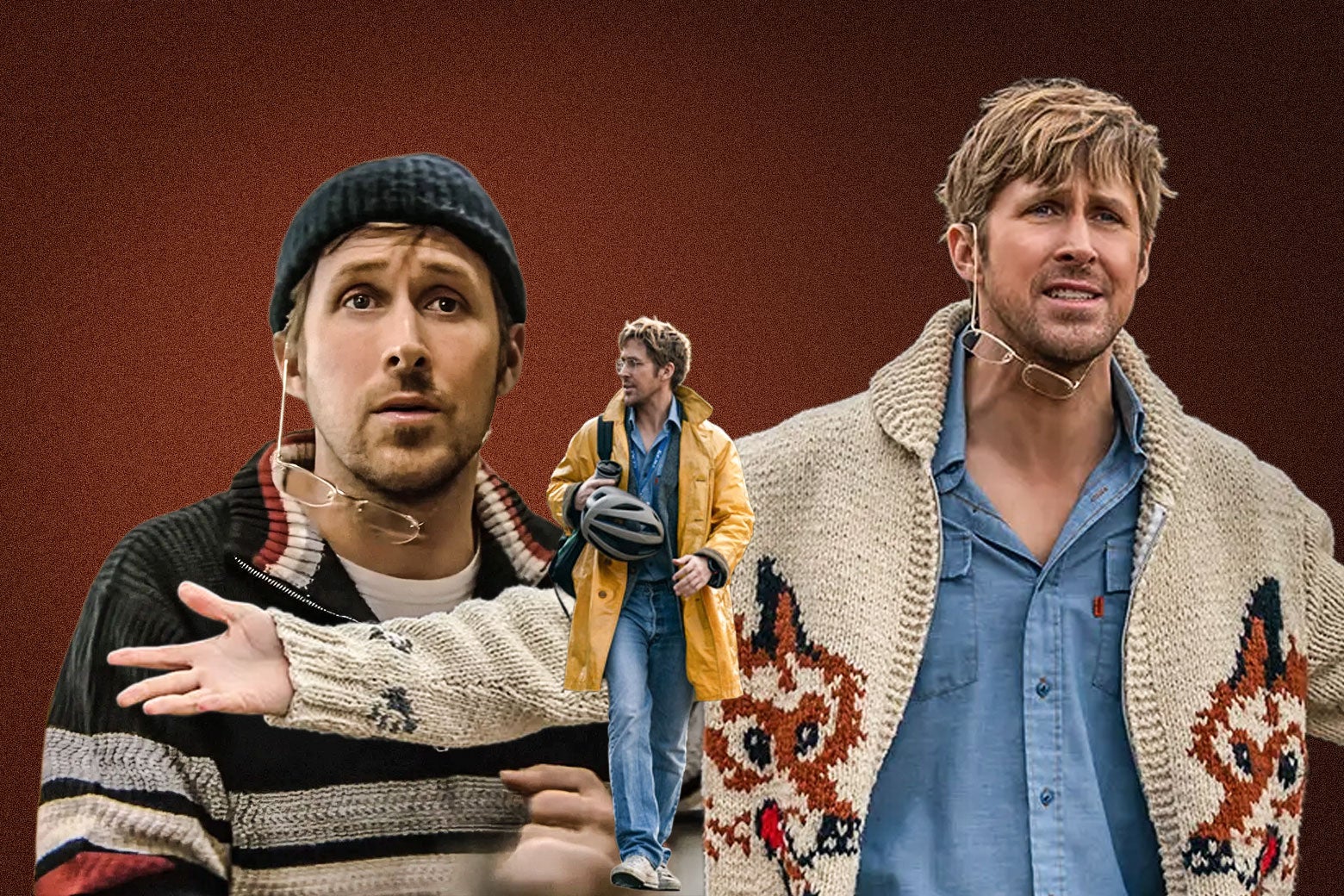
Ryland Grace is not mysterious—and he knows it. (“I talk too much,” he tells the alien Rocky, who is performed by puppeteer James Ortiz.) When a fan account on X invited its followers to “give me your seemingly useless Ryland Grace headcanons,” Grace’s admirers suggested: “Peanut allergy,” “He listens to Hadestown,” and “He trips a lot on his own feet but will look down and say ‘who put that there?’ ” You can see this quality of millennial cringe in the character details, such as Grace’s clothing choices. “It was about trying to find things that would bring it back a bit, so he’s not Robert Redford in space,” said one of the movie’s costume designers. Gosling suggested using science-humor T-shirts, as a callback to another (insanely good-looking) fictional nerd—Val Kilmer’s wiseass college senior in Real Genius. Then there’s the knitwear, appropriate for a teacher living in the Bay Area: That viral cardigan Grace wears in his Earthside scenes was nearly a more “aggressive-looking” one with wolves, until Gosling proposed an alternative, snugglier version, with foxes instead.
It’s that foxes cardigan Grace is wearing when he watches Eva Stratt (Sandra Hüller), the leader of the group that’s putting together the titular last-ditch mission to another solar system, sing karaoke at a crew party before the launch. Gosling emits powerful “I like you” vibes as he leans against the bar, staring at her, while she sings a song by fellow softboy Harry Styles, but the characters never kiss, and each actor has said that they perceive the attraction between the two to be platonic. (Gosling has noted that they simply “love each other’s brains,” while Hüller protests that “not everybody who’s working together falls in love.”) On the ship, Grace tells Rocky that he previously had a girlfriend but, improbably for a Gosling-level handsome guy who has the appealing job of teaching science to middle school kids, there’s not anyone waiting for him on Earth.
More than his wardrobe, his profession, or his affection for corny physics puns, it’s Grace’s human cowardice that marks his character as atypical for an action hero. In a recurring gag, Grace sits in a seat on his ship, then arches up out of it as the vessel’s A.I. reports “Pilot detected,” yelling: “Pilot NOT detected! Pilot NOT detected!” In every way, Grace wants not to be the pilot. (As he puts it at one point, “I put the not in astronaut.”) We find out partway through the movie that he never actually wanted to be on the ship but was conscripted onto it after an explosion killed the previous science officer. He refuses to go, even after Stratt points out that he has no family and is the only logical candidate for the job. Controversially, Stratt has him subdued and put on the ship by force. (For some readers of the Andy Weir novel on which the movie is based, this fact permanently soured them on Grace: “He is a lonely, selfish, obnoxious, cowardly, shameless, childish brat,” said one.)
Although Grace’s rejection of Stratt’s request was a possibly understandable act of human self-preservation—and although “the refusal of the call” is a centuries-old stage in the time-tested hero’s journey—we also know that in Grace’s case it’s part of a pattern of passivity: Grace gave up his scientific career after getting pushback on his one big theory about the nature of extraterrestrial life. He chose to teach instead, which equipped him with the soft skills—patience, the ability to connect, and a knack for communicating complex scientific concepts in a way that even middle schoolers, and extraterrestrials, can understand—that allow him to work with Rocky. But teaching is also a career in which nobody can truly challenge their most deeply held beliefs. “The movie pulls off the trick of highlighting how important teachers like Grace are, while also showing that in Grace’s case, teaching is a way of hiding from the research career that would have led to conflicts he might not win,” writes Leah Schnelbach for the science-fiction magazine Reactor.
Of course, these weaknesses in the character allow for Grace to grow—to bond with Rocky and get to a place where he can sacrifice himself for a friend. Imagine Project Hail Mary with a Ryland Grace who was self-assured and good at everything from the beginning. That’d be The Martian Part 2. Matt Damon’s Mark Watney, the hero of the previous Andy Weir adaptation, may dip his potatoes in Vicodin at a particularly grim moment, or make wry comments in his video logs about his misery and loneliness, but he would never leave dirty laundry on the floor of the spaceship or let himself wallow in despair. “Mark Watney could have done what Grace did but Doctor Grace could NOT have done what Mark did. Ryland Grace would be dead on Mars with ABBA blasting out the open doors,” wrote one fan on X (who simultaneously declared that Grace “is my favourite and most special boy of the two”). And that’s probably right. Mark Watney is the kind of dork who chooses to be an astronaut. Grace is the kind of dork who loves science, but never enough to go out on a limb—at least not until the fate of the universe, and of his cuddly, craggy little friend, depends on it. The viewer, like Stratt, can always see his potential, and watching him figure it out is the point.
Consuming too much information about niche online gender politics—and, possibly, too many guy-with-a-gun TV shows—has a way of souring your perspective on what most people find attractive in their fellow humans. Too much contact with the ideas alive in the manosphere could have you imagining that in our year of 2026, only the most domineering, muscle-bound, wealthy, violent men can compel others’ interest or respect. Project Hail Mary’s popularity has made a lot of viewers feel a little bit more optimistic—about the future of practical effects, about the future of movie theaters, and about the future of Ryan Gosling. But what I have found most heartening is the simple fact that this many people have enjoyed watching some science teacher be a total goof. That, to me, is hope.