Sign up for the Slatest to get the most insightful analysis, criticism, and advice out there, delivered to your inbox daily.
I can usually pick them out before I get close enough to read their shirts. There’s something in the way most combat veterans carry themselves in a crowd, not quite military bearing anymore (that gets worn down over time), but something residual, a way of standing that’s hard to describe but easy to recognize.
The “No Kings” protest in Austin, Texas, drew thousands on a warm late-March afternoon, a broad coalition of Texans who’ve had enough. And scattered through the crowd, wearing their identifying hats and T-shirts, were hundreds of veterans. I came looking for them specifically.
Most were from my generation, the GWOT generation, Iraq and Afghanistan vets, though there were plenty of Vietnam guys too, and Gulf War vets. With the Iran war now in its second month, the casualty count already climbing before a single boot has touched Iranian soil, I wanted to know what the people who’d actually done this for a living had to say about it.
Adrian is a former Army captain. We were wearing matching unit hats: We served in different brigades within the same infantry division. He was deployed to Afghanistan as a company commander while I was a squad leader in Iraq. He deliberately came to the protest in veteran gear because he believes visibility matters right now.
“I’m out here as a veteran because I think we have a particular awareness and a particular stake in service,” he told me. “Service to our country, service to the Constitution, selfless service.”
When I asked him about Iran, he didn’t give me talking points. He turned to terrain and troop strength and strategic objectives.
“Airpower isn’t going to do anything. You’re not going to accomplish anything lasting without infantry on the ground. You can’t achieve sustained effects by strategic bombing. You can’t get there without putting boots on the ground. So, then, what is your objective? What are you trying to do?”
He paused. “I’m a former war planner, and I still don’t understand what we’re trying to do.”
When the subject turned to the Strait of Hormuz, closed within days of the first airstrikes, something the administration claimed no one could have predicted, Adrian shook his head. In 2009, he told me, he worked on a graduate research project on exactly that chokepoint: how critical it was, how catastrophic its closure would be for the global economy. That paper went to Washington. It went to the Pentagon. That was 17 years ago.
“That’s how long we’ve all known about the Strait of Hormuz,” he said.
He’s worried about where this all goes, not just strategically, but in the way people who’ve watched these things unfold before get worried. There is a particular dread of recognition.
“Trump has got the tiger by the tail right now, and it’s only going to get worse. They’ve already sent one MEU [Marine Expeditionary Unit] from Okinawa and one from Pendleton. That’s like 5,000 Marines. If he puts the 82nd on the ground in Iran, he’s not going to be able to break contact. It’ll be like Nixon in Vietnam: I can’t lose, I can’t leave. We’re slowly getting into quicksand.”
He also talked about the sycophantic culture that has taken hold at the Pentagon and the Joint Chiefs. He’s worried about that because his work on the Strait of Hormuz assures him that plenty of people plenty high up were aware of the risks of going to war with Iran. “Everyone in our community knows this stuff,” he said. “And my guess is they warned them, and they either blew them off, or they’ve got so much of a yes-man culture over there now that they’re not even being honest. So it’s one of the two.”
Adrian had lost people in Afghanistan. We talked about Abbey Gate, where 13 American service members were killed as the U.S. was pulling the military out of the country. Trump and his allies spent years using these deaths as a cudgel against the Biden administration. That same number, along with over 300 wounded, had already been reached in the conflict with Iran, in a matter of weeks, and the response from the commander in chief has been something close to a shrug.
Adrian thinks it’s going to get much worse. Iran, he reminded me, has around 90 million people and an estimated 200,000 in the armed militia and paramilitary forces. “Bloodier,” he said, when I asked how this might compare to Iraq and Afghanistan. “Bloodier than both of them.”
David, whose name I’ve changed because he is still serving, is a lieutenant colonel and physician in the Army Reserve. “I feel like the lives of the soldiers that I care for and that I treat are being wasted to protect money and interests, as opposed to rights and freedoms,” he said.
He’s been deployed multiple times over a long career, including in Afghanistan. In each of those places, he said, he felt like the presidents he served under had represented him well to the world. That feeling is gone now.
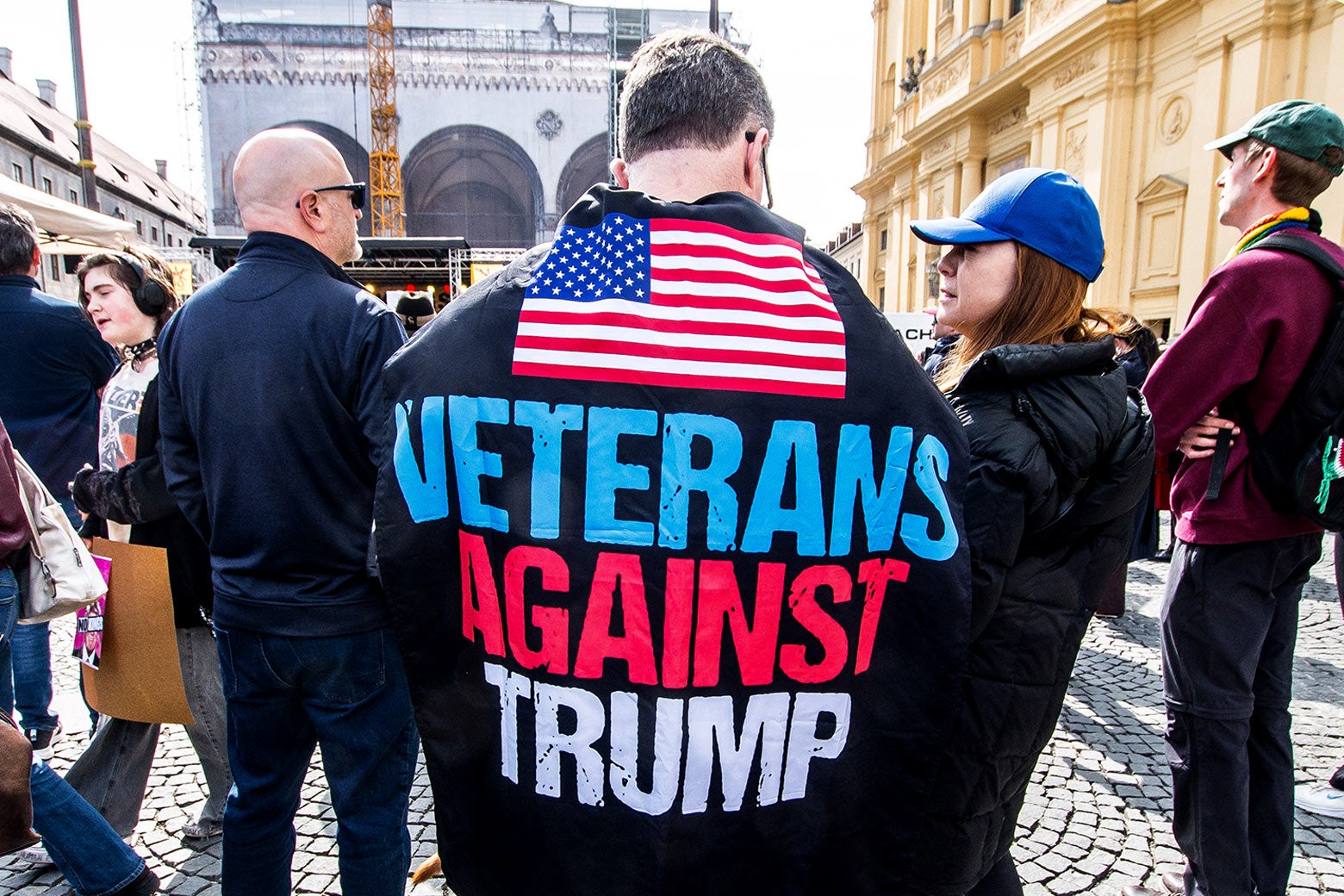
David was wearing an OD-green Veterans Against Trump shirt, and while we talked, a woman stopped to thank him for his service and for being there. He said she wasn’t the only person who had done so that day.
Anna served 22 years in the Army Reserve, including a tour in Iraq. She wasn’t subtle about why she retired as soon as she could after Trump’s second inauguration.
“I saw the writing on the wall. When Trump got into power the second time, I realized that our military was not in good hands, and I retired pretty much as soon as I could. What he’s doing with the military, with Hegseth, is really disturbing to me. And now this illegal war in Iran is just very unsettling.”
Jessica served in the Army and came to the protest thinking about who gets counted and who gets erased. She reminded me that one of the very first casualties of the Iran war was a woman, at the exact moment the Department of Defense was actively working to downplay and erase the contributions of women and minorities in military service. The timing, she said, left her sick. That’s part of why she showed up.
Matt served multiple tours in Iraq and Afghanistan as an infantry squad leader and gunnery sergeant in the Marine Corps. He was blunt in the way Marines tend to be. “Trump has surrounded himself with people who constantly suck up to him all day,” he said. “Anybody competent from that first administration, guys like General Mattis, for instance, is gone. Because Trump can’t take criticism. He has no honor, no integrity. And he really seems to think he’s some kind of king or dictator, that what he says is the law.” He shook his head. “Fuck that. I didn’t swear a fuckin’ oath to that dude. I swore it to the Constitution. And as far as I’m concerned, that oath never fuckin’ expires.”
Walking back to my car at the end of the day, I kept thinking about what Adrian had said about Trump needing to take the loss in Iran to prevent losing even more. Anyone who’s watched these wars up close knows how this math works. The bill only gets larger. And anyone who’s watched Trump knows that he has never admitted to failing at anything, and walking away from Iran now would require exactly that. Nobody I talked to is holding their breath. They just all understand the price.