Sign up for Executive Dysfunction, a weekly newsletter that surfaces under-the-radar stories about what Trump is doing to the law—and how the law is pushing back.
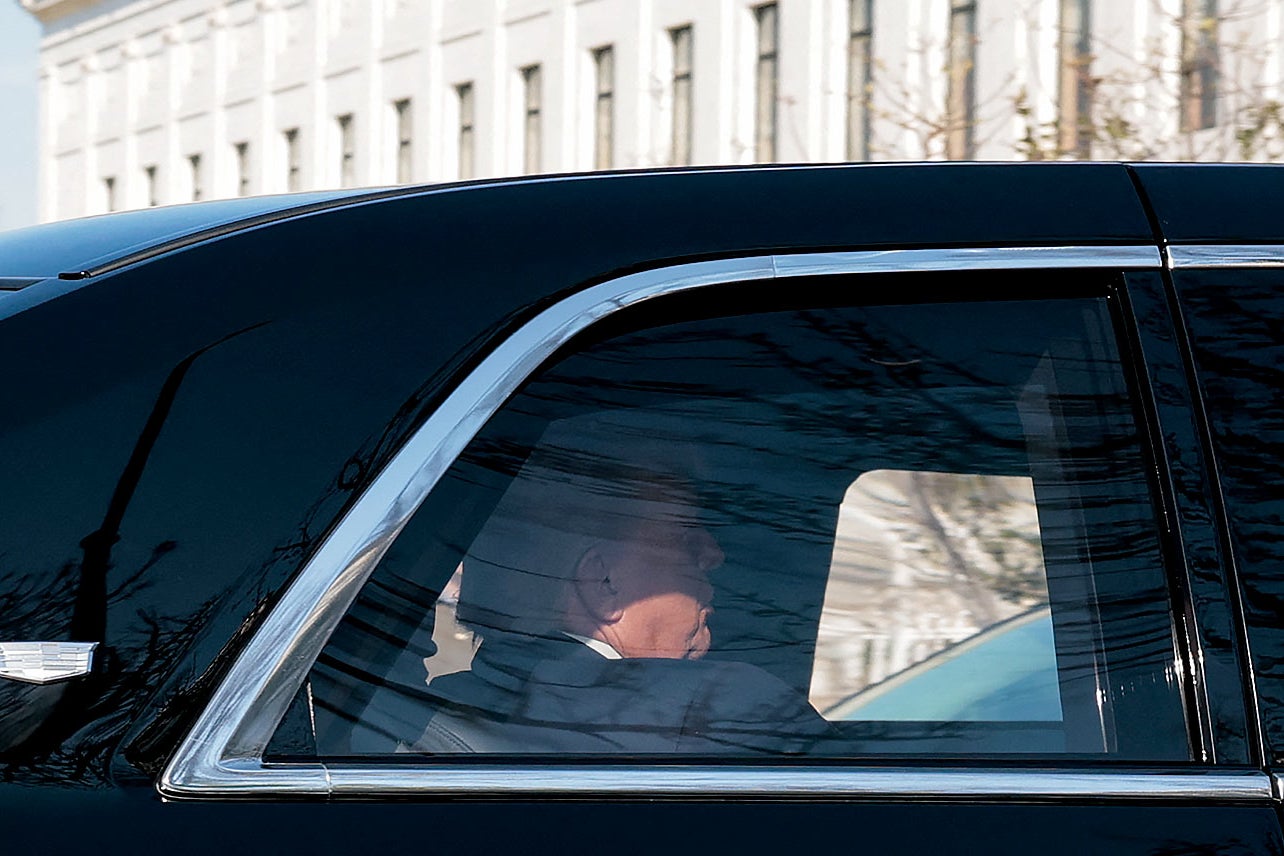
On Wednesday, Donald Trump became the first sitting president to attend Supreme Court arguments in person. It must have been a brutal morning for him. The justices heard Trump v. Barbara, a challenge to the executive order purporting to strip birthright citizenship from the children of many immigrants—and it quickly shaped up to be a blowout against the administration. Seven justices expressed profound skepticism toward the government’s revisionist history of the 14th Amendment, with most sounding downright hostile toward the pseudo-originalist theory cooked up to legitimize the policy. Only Justices Clarence Thomas and Samuel Alito asked questions friendly to the administration, and none of their colleagues sounded persuaded by their strained defenses. It appears that Trump’s attack on birthright citizenship—in some ways, the centerpiece of his nativist immigration agenda—is about to go down in flames.
From the outset, the justices gave Trump’s solicitor general, John Sauer, a frosty reception. He pressed an ahistorical, atextual theory of the 14th Amendment’s citizenship clause, which declares that “all persons born or naturalized in the United States, and subject to the jurisdiction thereof, are citizens of the United States and of the State wherein they reside.” The clause’s central purpose was to grant citizenship to newly freed slaves and their children. When ratifying the amendment in 1868, however, Congress explicitly recognized that it would also apply to the American-born offspring of immigrants. The Supreme Court affirmed that principle in 1898’s Wong Kim Ark, and ever since, these children have received U.S. citizenship at birth regardless of their parents’ immigration status. Nonetheless, Trump issued an executive order on his first day back in office ordering the government to deny citizenship to the children of immigrants who lack permanent legal status and temporary visa-holders.
To justify this unprecedented order, Sauer tried to rewrite the 14th Amendment’s history with the aid of recent “scholarship” parsing the phrase “subject to the jurisdiction thereof.” He claimed that the citizenship clause only applies to the children of parents who owed “direct and immediate allegiance” to the United States, and that Wong Kim Ark applied only to those who were “domiciled” here. The children of “temporary visitors,” including immigrants, would not receive citizenship under this theory—both because their parents owed “allegiance” to a foreign power and were not truly “domiciled” in this country.
But this theory is entirely false, based on hastily assembled “academic” work that’s riddled with errors and lies. And a majority of the justices recognized it. Chief Justice John Roberts openly scoffed at Sauer’s efforts to broaden the citizenship clause’s acknowledged exceptions, which apply to the children of diplomats, enemy soldiers, and (at the time of ratification) Native people outside the federal government’s jurisdiction. The solicitor general sought to “expand” these “tiny” and “idiosyncratic” classes to cover a “big group” of immigrants today, Roberts noted. Can this narrow exception really be stretched so far?
Sauer pivoted to policy arguments, asserting that the Framers of the 14th Amendment couldn’t have imagined “problems” we face today, including illegal immigration and “birth tourism.” He told Roberts that foreigners can now hop on a plane, give birth in the U.S., and bestow American citizenship upon their children. Shouldn’t the court stretch the 14th Amendment’s original exceptions to cover new groups that the Framers couldn’t have imagined? The chief justice was not convinced. “It’s a new world,” he quipped. “It’s the same Constitution.”
An audibly hostile Justice Neil Gorsuch was no less impressed. He questioned Sauer’s reliance on “Roman law sources” and other obscure citations while pointing out that more relevant, authoritative sources cut against his argument. The justice even quoted Justice John Marshall Harlan, who dissented in Wong Kim Ark, acknowledging that the decision established citizenship for the children of all immigrants. He also pushed Sauer to say whether his rule would deny birthright citizenship to all Native people, which the solicitor general could not answer definitively. (Given Gorsuch’s strong support for Native rights, that non-answer surely failed to satisfy him.)
Justice Amy Coney Barrett asked Sauer a mix of practical and theoretical questions that revealed the incoherence of his position. She asked him to think about a victim of human trafficking who is brought to the U.S. illegally then gives birth here. Would her child, she asked, be denied birthright citizenship? Sauer couldn’t give a straight answer, which seemed to frustrate the justice. She also highlighted the unworkable nature of the government’s proposal; if a child’s citizenship hinges on a parent’s “domicile,” she told Sauer, then “you have to adjudicate both residency and intent to stay.” But how do you do that? And what about “foundlings”—children with no known parents, who were well known to the ratifiers of the 14th Amendment? Sauer assured her that Trump’s executive order addressed this situation, to which she responded: “Yeah, but what about the Constitution?”
Justice Brett Kavanaugh, as well, came out of the gate poking holes in Sauer’s argument. The solicitor general, he noted, kept saying that the Civil Rights Act of 1866 denied birthright citizenship to children who were “subject to any foreign power.” And he sought to import this limitation into the 14th Amendment. But the Framers of the citizenship clause did not import those words into the “text” of their amendment, Kavanaugh said. Congress made the affirmative decision to broaden its grant of birthright citizenship from the earlier statute. So why should the court now impose a restriction that does not appear anywhere in the Constitution? Kavanaugh was also unimpressed by Sauer’s reminder that most European countries do not recognize birthright citizenship. Why, he asked, was that even relevant? “We try to interpret American law with American precedent based on American history,” the justice told Sauer. “That’s certainly what I try to do. … Why should we be thinking about, Gee, European countries don’t have this?”
With all three liberal justices openly opposed to Trump’s executive order already, it is easy to count five votes here. Really, it is easy to count seven; only Justices Thomas and Alito sounded genuinely convinced by any of Sauer’s arguments. Thomas suggested that the 14th Amendment marked an effort to overturn Dred Scott and therefore applied only to freed slaves. Alito implied that the citizenship clause should exclude immigrants who lack permanent legal status because they can be arrested and deported and therefore lack true “domicile” here. He also conceived a laughable hypothetical wherein an Iranian citizen gave birth here and their child was subject to the laws of Iran and so had a duty to serve in Iran’s military, with the apparent implication that the child would emerge 18 years later as sleeper agent.
But none of the other justices appeared to be won over by these hypotheticals. When the American Civil Liberties Union’s Cecillia Wang approached the lectern to contest Trump’s order, she received mostly softballs that sought to shore up her argument and patch any potential weak spots. She did not receive a single question that indicated any justice besides Thomas and Alito was seriously considering upholding the policy.
The one wrinkle here is Kavanaugh. He alone seemed keenly interested in the statutory argument against the administration. Congress, he reminded both Sauer and Wang, enshrined the citizenship clause into federal law in 1940 and 1952. By that point, lawmakers appear to have understood this provision to cover the children of all immigrants no matter their parents’ status. Couldn’t the court issue a narrow ruling against Trump based on that statute and leave the constitutional question for another day? Wang was wary of this approach, because it would give Congress room to enact a new statute in the future that takes away birthright citizenship from the children of some immigrants. And at points, Kavanaugh sounded eager to do exactly that—give lawmakers the freedom to pass a version of Trump’s executive order as a federal statute. But his colleagues sounded more inclined to settle the constitutional question now. Even Kavanaugh’s compromise approach, though, would render Trump’s executive order unlawful today.
In truth, Trump v. Barbara should be 9–0, and it is alarming that even two justices would entertain the possibility of upholding this policy. But given the reality of this Supreme Court, it’s still quite assuring to see a cross-ideological majority of the justices line up to explain that, yes, the 14th Amendment means what it says. If Trump sought to intimidate them by showing up in person, his strategy failed miserably; they sounded just as resolute as they did when assessing the president’s erstwhile tariffs. The Republican-appointed justices at the center of the court remain happy to hand him a victory whenever his agenda aligns with theirs. But when those agendas conflict, these justices seem to relish the opportunity to remind the president that they can still tell him no anytime they please.