Sign up for the Slatest to get the most insightful analysis, criticism, and advice out there, delivered to your inbox daily.
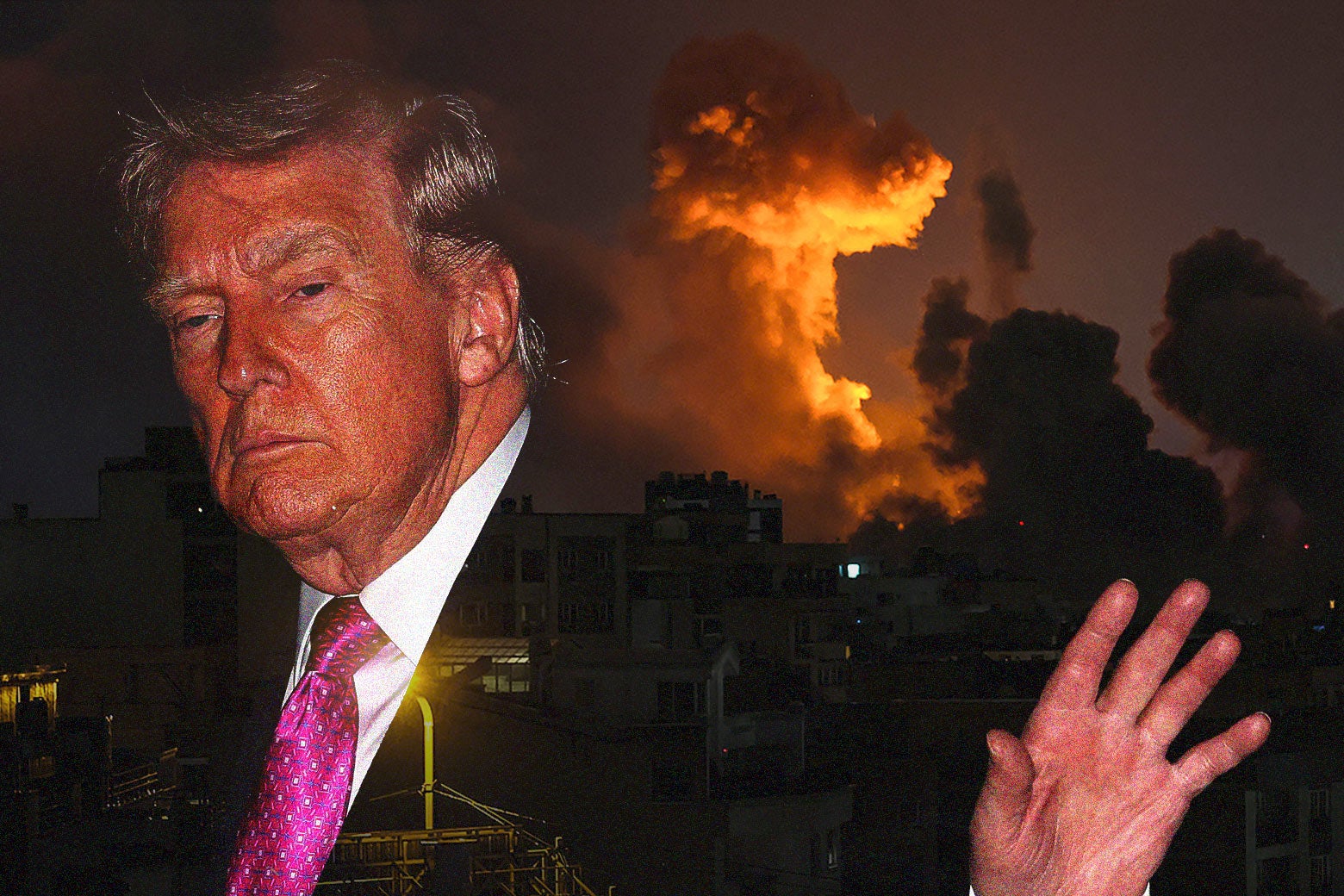
President Donald Trump is faced with a dramatic choice: either to escalate his war on Iran by sending in ground troops—or to pull out altogether. For the past month, he’s simply been bombing as many targets as U.S. intelligence can identify, on the assumption that massive firepower precludes the need for a strategy.
It’s clear this mindlessness is no longer tenable. He has killed Iran’s top echelons of leaders and blown up a lot of structures, but the basic elements of the regime—a theocratic state fueled by an oppressive elite military, reduced in arms but still powerful, with the stuff of a potential nuclear arsenal hidden away—remain.
Trump may announce, in a prime-time speech tonight, that he has accomplished his aims—but he hasn’t. (He claimed on Tuesday that he has accomplished regime change by killing a bunch of leaders, but this only shows that he doesn’t know what the phrase regime change means.) At the height of the Vietnam War, Sen. George Aiken famously advised President Lyndon B. Johnson to “declare victory and go home.” Trump may be about to do just that. It’s hardly the worst of his options, but it would bolster the growing impression, here and abroad, that the president is a wayward missile who has turned the United States into an unsteady ally—even a rogue nation.
Then again, who knows what Trump will announce tonight—or what he will do in the next days and weeks? In recent times, he has said that the war might be over “very soon” and that it could go on for a long time. He has demanded “unconditional surrender” and shrugged that he might end the war even if Iran doesn’t reopen the Strait of Hormuz. In other words, he might leave the United States and the world worse off than before the war began.
There is a school of thought that Trump acts crazy and unpredictable in order to discombobulate his enemies, even scare them into submission, as Richard Nixon tried (but, it’s often forgotten, failed) to do with his “madman theory.” Maybe. But this trait, if that’s what it is, also boxes Trump—and the rest of us—into a multipronged trap. The enemy will likely take his words seriously and prepare to stave off his threats. If Trump backs down (possibly because he detects these preparations), he risks looking weak, thus emboldening not only the enemy at hand (in this case, Iran) but enemies worldwide who are watching (e.g., Russia, China, and North Korea). And so, because he abhors looking weak, he may act on his threat, against his better judgment, escalating the violence.
According to news reports over the past week, Trump has been weighing three possible missions for ground troops, in hopes of eking out some sort of victory: 1) opening up the Strait of Hormuz, the narrow waterway through which a quarter of the world’s oil passes, which Iran is now blocking, 2) occupying Kharg Island, the center of the country’s oil production, and/or 3) pilfering Iran’s supply of enriched uranium, which the president said U.S. bunker-busting bombs had “obliterated” last June—but some of which, it now appears, was moved elsewhere before the attack.
The problem is, each of these missions is extremely difficult and would very likely widen and prolong the war still further. If Trump decides to end the war now, it may be that his top military advisers have convinced him that the alternative would widen and prolong the war too much.
I have not seen official estimates of how many troops it would take to secure the Strait of Hormuz, but a retired Navy officer, who used to plan these sorts of operations figures and still analyzes them for classified think tanks, told me it would take “many thousands” to occupy the land surrounding the strait—and thousands more to “sustain” the occupation, meaning to supply the troops with munitions, food, water, shelter, air support, and defensive weapons to shoot down Iranian drones and cruise missiles.
The last obstacle is the main one. Troops securing the area, whether on the shores or on warships accompanying oil tankers through the strait, would be sitting ducks for Iranian drones and cruise missiles, which have the range and accuracy to be launched from hills many miles inland. The Iranians no doubt anticipate that Trump might send troops, ships, and planes to secure the waterway—in which case they have also deployed drones and missiles to return fire.
Secretary of Defense Pete Hegseth admitted at a Pentagon press conference on Tuesday that, despite the massive U.S. and Israeli air raids, Iran still has a lot of missiles and drones. Nobody knows how many, but it doesn’t take too many for it to exert a lot of leverage.
Early on in the war, Hegseth bellowed that this conflict was “not a fair fight,” nor should it be; the U.S. and Israeli forces far outgun Iran’s. But a war for control of the Strait of Hormuz would likely turn the tables. If the Iranians sank a couple of tankers or inflicted substantial damage to one U.S. warship, they could deter a lot more tanker captains from entering the waterway of doom and thus continue to wreak havoc on the world economy. And if the Iranian volleys killed or wounded a fair number of the U.S. troops stationed on Iranian soil, the political calls for ending the war—whose purpose Trump has never made clear—would intensify.
The war would get still harder and deadlier if the Iranian army and the elite Islamic Revolutionary Guard Corps took the occupation as a full-scale invasion and reacted accordingly. Many of the Iranian people, even those who deplore the regime, may support the home team in this fight. Iranians are generally ill-disposed to foreign intervention. The 1953 coup, mounted by the CIA and British intelligence to overthrow the elected socialist prime minister, Mohammad Mossadegh, and to replace him with the shah, continues to weigh on the popular consciousness—“the ghost of Mossadegh,” the syndrome is often called. Trump seems to believe that simply demonstrating U.S. military power causes tyrants and whole populations to tremble. His emissary Steve Witkoff said the president was “curious” as to why the Iranians didn’t fold at the sight of two U.S. aircraft carriers and their battle groups entering the Persian Gulf. They might not fold at the sight of Marines storming their beaches either; in fact, they might be galvanized.
It’s unclear why Trump wants to occupy Kharg Island, Iran’s main oil-export terminal. He has said, at varying times, that he wants to destroy it, as punishment for Iran’s refusal to surrender, and that he wants to seize it, in order to “take” Iran’s oil. Either way, it’s a puzzler. First, the U.S., which has been a net energy exporter since the Biden administration, doesn’t need the oil. Second, destroying the terminal, and thus reducing the amount of oil on the world market, would only raise prices further. Finally, Kharg is 200 to 300 miles from the Strait of Hormuz; seizing the one and securing the other would be two widely separated operations—again widening the war and requiring still more troops and logistical support.
Finally, there’s the idea of seizing Iran’s uranium, which may seem related to one of Trump’s original goals for the war (to keep Iran from building a nuclear bomb) but is also, in many ways, the most challenging.
U.S. special operations forces have devised plans for seizing the nuclear weapons, facilities, and materials of many hostile or turbulent countries. (About 10 years ago, a Navy officer I knew told me he had helped write the 400-page operation plan for invading Pakistan and seizing its nuclear weapons.) Various branches of the military draw up plans for all sorts of contingencies in case the president thinks about ordering one. Just because a plan exists doesn’t necessarily mean that it’s a recipe for success. And a plan for capturing Iran’s nuclear supply—assuming one exists—is anything but.
First, it’s unclear that anyone knows where the uranium is. (Iranians know that we might come to get it, so they could be hiding it in very deep tunnels or maybe putting out pseudo-intelligence, which they hope U.S. analysts would intercept as genuine, on its location.)
Second, this would be an elaborate operation. It’s not known, publicly anyway, how much enriched uranium Iran has. It was thought to possess about 1,000 pounds of it before last June’s attack; the country probably still has hundreds of pounds. The special-ops forces would have to sneak into Iran, find the stuff, perhaps burrowing into tunnels to do so, and somehow take it elsewhere. Not only that, but other troops would have to come along to set up “perimeter defenses,” i.e., to protect the special-ops soldiers from Iranian detection and attack.
Perhaps this could all be done more quickly than securing the Strait of Hormuz or occupying Kharg, but it’s not an in-and-out operation like Venezuela. The feat would take some time. Soldiers, marines, and their support crews need food, water, ammo, and other supplies; a base of some sort would have to be set up.
Military operations are more complex than many people think, especially if they involve invading a hostile country and there aren’t many accessible bases in surrounding countries. Soldiers firing guns on the ground are only a small part of it. There are drones and piloted planes flying overhead all the time, ships in nearby harbors launching missiles, air-defense crews shooting down incoming fire, intelligence agents tracking the enemy and intercepting communications, and a long, long tail of logistics crews providing endless supplies.
The U.S. is said to have about 50,000 military personnel in the area around Iran—about 10,000 more than there were before the war started. The retired Navy officer, who has planned and analyzed military requirements of this sort, says he figures at least 100,000 would be needed to secure the Strait of Hormuz, occupy Kharg Island, and seize Iran’s enriched uranium—possibly many more, and for a long period of time.
The lightning-swift nabbing of Nicolás Maduro in Venezuela, the sinking of suspected drug boats in the Caribbean, and the precision bombing of uranium sites in Iran last summer have misled Trump into assuming that all military operations (all those ordered by him, anyway) are easy and have whetted his appetite for more. However, he has tended to stop short of shooting at people who can fire back—and that is what he would be facing by putting boots on the ground.
Then again, he seems to think that the usual lessons of history don’t apply to him (which is why he doesn’t think he needs to study them). In June, when Trump launched his first attacks on Iran, Vice President J.D. Vance said he understood the widespread concern about getting stuck in another Middle East war, but, he added, “the difference is that, back then, we had dumb presidents, and now we have a president who actually knows how to accomplish America’s national-security objectives. So this is not going to be some long, drawn-out thing.”
The events of the past month, since Trump started the bombing raids on Iran, have shown that, in fact, we have a president who doesn’t know what America’s national-security objectives are, much less how to accomplish them. And so we don’t know how cautious Trump might be in these circumstances, or how carefully he’ll avoid the trap of escalation.
A recent comment by Vance is far from reassuring, though he meant it to be. Last year, the vice president waved off the possibility that Trump might get stuck in a Middle East war for months. This past Saturday, on the Benny Show podcast, Vance said, “We’re not interested in being in Iran a year down the road or two years down the road” (emphasis mine).
That rather extends the deadline from his earlier projections and from recent statements by Secretary of State Marco Rubio that the war would be over in another two to four weeks. However long it takes, Vance said on the podcast, “we’re taking care of business.” It’s too bad that nobody knows—Trump himself included—just what business we’re taking care of.