Sign up for the Slatest to get the most insightful analysis, criticism, and advice out there, delivered to your inbox daily.
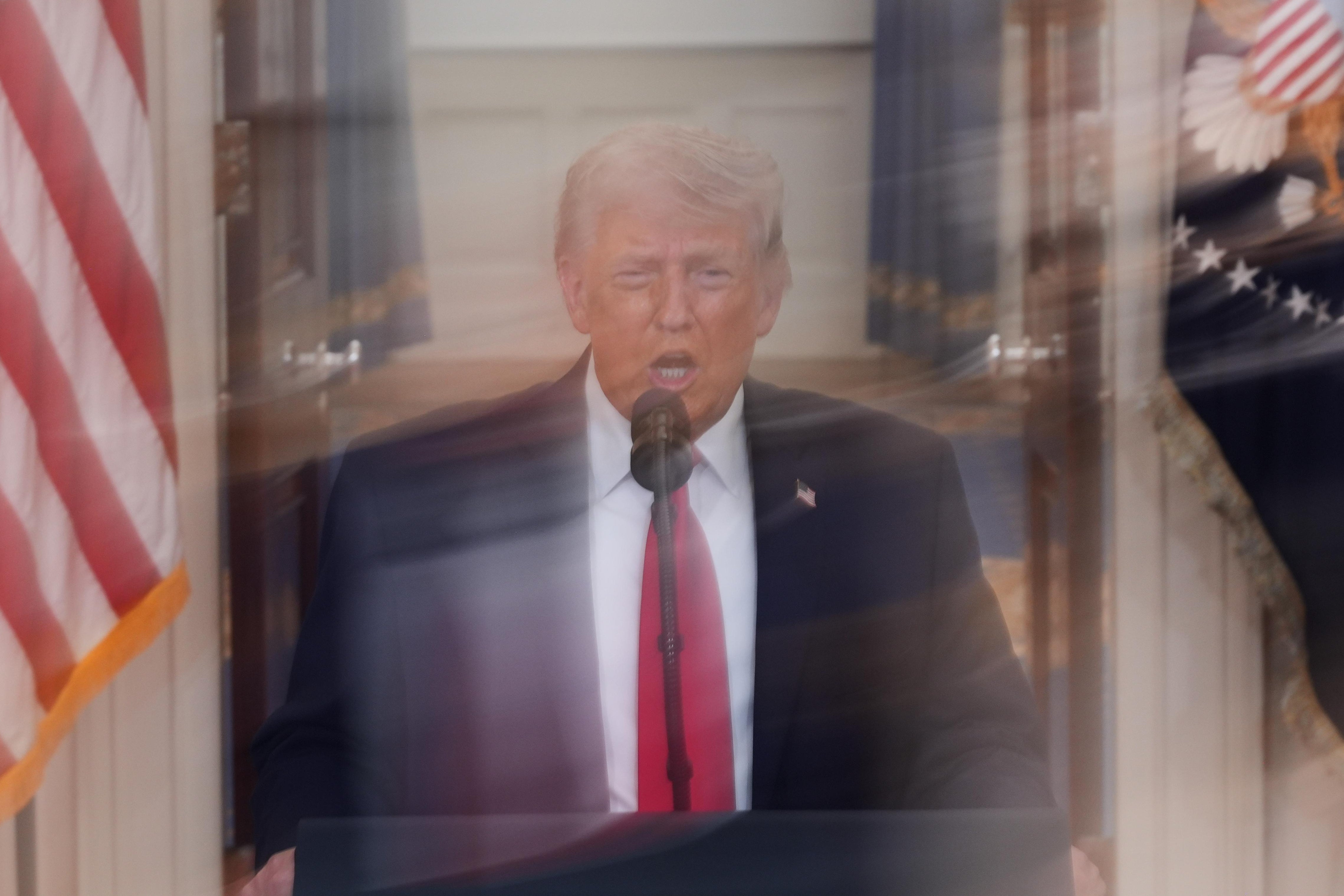
The White House heralded it in advance as a “major address,” but President Donald Trump’s actual prime-time speech on Wednesday—what he called “an update on the tremendous progress our warriors have made in Iran”—was a big nothing.
News stories, citing inside sources, had reported that Trump was thinking about escalating the war—even sending in ground troops—or exiting it very quickly. Yet judging from the speech, he’s doing neither. Instead, he’s intent on keeping up the bombing, hitting Iran “extremely hard over the next two to three weeks … to bring them back to the Stone Ages, where they belong”—a malapropism of Gen. Curtis LeMay’s call in the 1960s to “bomb them”— meaning North Vietnam—“back to the Stone Age.”
It was the first speech Trump has delivered on his and Israeli Prime Minister Benjamin Netanyahu’s war on Iran, now in its second month—yet he still offered no serious explanation of why he started it, when it will end, or how anyone should define victory. Instead, he crammed the 20-minute address with many of the lies he’s told many times before and invented a few new ones.
Sometimes it’s worth cataloging the lies and distortions in one of his speeches to show just how incapable he is of telling—or perhaps recognizing—the truth. Because this speech was billed as so important, yet carried so little real news, it offers another opportunity.
So let us begin.
Claim: “In these past four weeks, our armed forces have delivered swift, decisive, overwhelming victories on the battlefield, victories like few people have ever seen before.”
Fact: U.S. and Israeli bombs and missiles have destroyed many targets but racked up no “victories” (if that word has any meaning). Iranian leaders have been killed, but the regime—a theocratic state empowered by a repressive well-armed military—remains intact. A lot of their missiles have been hit, but Iran is still launching a fair number each day.
Claim: “I did many things during my two terms in office to stop the quest for nuclear weapons by Iran. … I killed Gen. Qassem Soleimani. … I terminated Barack Hussein Obama’s Iran nuclear deal … [which] gave them $1.7 billion in cash … [and] would have led to a colossal arsenal of massive nuclear weapons for Iran.”
Fact: Killing Soleimani was a big deal, but the terrorist commander had nothing to do with Iran’s nuclear program. The Iran nuclear deal, signed by Obama and six other leaders, then sanctified into law by the U.N. Security Council, in fact halted Iran’s nuclear program, forced Iran to dismantle most of it, and allowed strict international inspection. The $1.7 billion in cash referred to Obama’s return of Iranian money, which the U.S. had confiscated when Iran covertly started a nuclear program. Trump’s scuttling of the deal and his reimposition of sanctions prompted Iran to restart the program, bringing the country closer than ever to an A-bomb.
Claim: “My first preference was always the path of diplomacy, yet the regime continued their relentless quest for nuclear weapons and rejected every attempt at an agreement.”
Fact: The week before Trump started Operation Epic Fury, Iranian negotiators presented a proposal that was actually pretty favorable to us; it would have required them to scale back enriched uranium even more than Obama’s deal had done. U.S. officials said talks would resume on Monday. The Saturday before, Trump launched his surprise attack.
Claim: “In Operation Midnight Hammer,” Trump’s attack on Iran’s enrichment sites last June, “we totally obliterated those nuclear sites. The regime then sought to rebuild their nuclear program at a totally different location, making clear they had no intention of abandoning their pursuit of nuclear weapons.”
Fact: Trump’s own director of national intelligence, Tulsi Gabbard, testified just two weeks ago that Iran had not rebuilt its nuclear program since Midnight Hammer.
Claim: “They were also rapidly building a vast stockpile of conventional ballistic missiles and would have soon had missiles that could reach the American homeland, Europe, and virtually any other place on earth.”
Fact: They were building more missiles, yes. But Trump’s own top intelligence officials have said there is no evidence that Iran was anywhere close to building missiles with the range to strike the U.S.
Claim: “Our objectives are very simple and clear … we will cripple Iran’s military, crush their ability to support terrorist proxies, and deny them the ability to build a nuclear bomb.”
Fact: The third aim is the main one (he cited it at the start of his speech), but later in the speech he pretty much said this had long ago been accomplished. “The nuclear sites that we obliterated with the B-2 bombers [last June] have been hit so hard that it would take months to get near the nuclear dust,” he said. “And we have it under intense surveillance and control. If we see them make a move, even a move for it, we’ll hit them with missiles very hard again. We have all the cards. They have none.” If this is true, why did he go to war in late February?
Claim: “We built the strongest economy in history. … We’ve taken a dead and crippled country—I hate to say that but we were a dead and crippled country after the last administration—and made it the hottest country anywhere in the world by far.”
Fact: No public appearance by Trump can go without kicking Joe Biden in the shins (or higher up), but “dead and crippled”? Job growth, unemployment, and GDP growth were all better under Biden’s last two years than they have been under the first year of Trump’s current term. It is odd that Trump even went here in this speech, as polls—which show his ratings on the economy at a new low—suggest few people, even among his supporters, believe the economy is so hot.
Claim (continuing the point): “With no inflation, record-setting investments coming into the United States, over $18 trillion, and the highest stock market ever.”
Fact: Inflation is at 2.4 percent and rising, high enough for the Federal Reserve to vote against lowering interest rates. Actual foreign investment amounts to a few hundred billion dollars, no higher than during Biden’s presidency. The stock market has risen, mainly because of the go-go growth (some would say “bubble”) of A.I. corporations. That said, the S&P 500 has declined each week since the war began. And while it rose 3 percent on the day of Trump’s announcement, mainly on reports that he would end the war quickly, the futures market tanked—and future oil markets rose—while he was giving his speech.
Claim: “The United States imports almost no oil through the Hormuz Strait. … We don’t need it. … And the countries of the world that do receive oil through the Hormuz Straight must take care of that passage. … They must grab it and cherish it. They could do it easily.”
Fact: First, the global oil market is a global market. The U.S. might not depend directly on the oil that passes through the Strait of Hormuz, but Iran’s restrictions of that passage affect our oil prices, like everyone else’s. Second, our allies could not “grab” the Strait “easily.” We couldn’t do so either. Even given Iran’s much-reduced missile force, one well-aimed drone or missile at an oil tanker or escorting warship passing through could discourage other tankers from following along. It’s worth recalling that the strait was open before the war started. One way to reopen it might be to end the war.
Claim: “Regime change was not our goal … but regime change has occurred because of all of their original leaders’ death. They’re all dead. The new group is less radical and much more reasonable. Yet if during this period of time no deal is made … we are going to hit each and every one of their electric generating plants very hard.”
Fact: Trump and his top aides have said contradictory things about whether regime change is one of the war’s goals, but his continued railing against the regime’s evil—and his boasts about killing its top leaders—would make no sense if it weren’t a goal. Second, as noted before, the regime is very much intact, even if the original leaders are not. Third, there is no evidence that “the new group” is “more reasonable,” presumably meaning more inclined to make a deal that pleases Trump. In fact, given the killing of the top echelons and the destruction of command-and-control, it’s not clear who has the authority to strike a deal with the U.S. Finally, threatening to destroy Iran’s electric grid—a war crime—is hardly the sort of attitude to make them more reasonable.
Claim: “The whole world is watching, and they can’t believe the power, strength, and brilliance, they just can’t believe what they’re seeing, they—leave it to your imagination—but they can’t believe what they’re seeing, the brilliance of the United States military.”
Fact: The speed, power, and precision of U.S. air and naval power is indeed something to behold. (The accuracy of the data that goes into the bombing campaigns is another matter; hence the mistaken, though very accurate, bombing of a school and an athletic center that killed many children.) What the world is watching with wider eyes, and what they really “can’t believe,” is the aimlessness, arrogance, ignorance, and shamelessness of this well-honed military’s commander in chief—his pretense to imperialism with barely a shrug toward the responsibility that has historically gone with it. That, more than anything, was what was on dismal display Wednesday night.