This is Executive Dysfunction, a newsletter that highlights one under-the-radar story about how Trump is changing the law—or how the law is pushing back—and keeps you posted on the latest from Slate’s Jurisprudence team. Click here to receive it in your inbox each week.
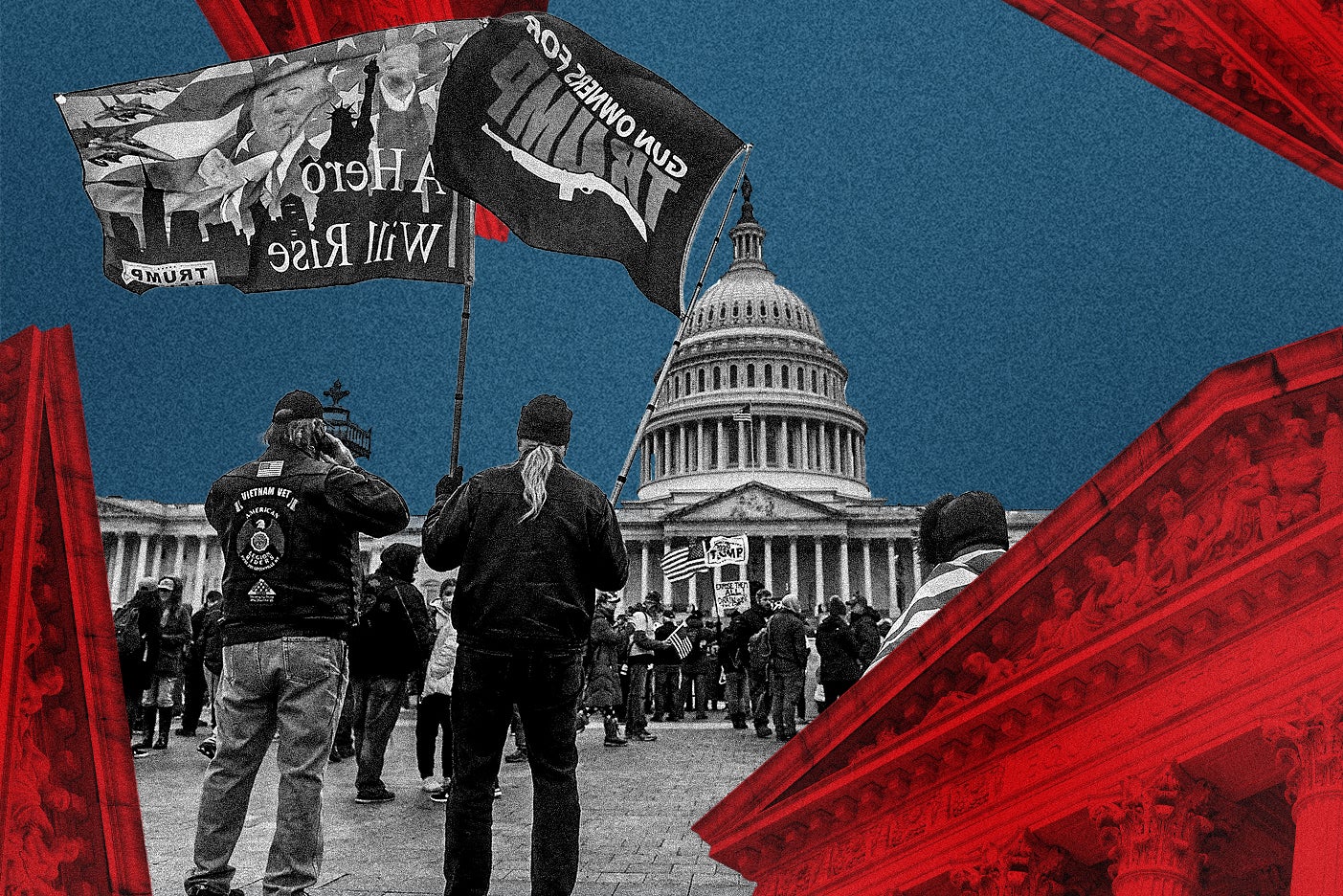
Apparently, President Donald Trump’s “full, complete and unconditional” pardon for the roughly 1,500 rioters who violently assaulted the U.S. Capitol building and Washington police officers on Jan. 6, 2021, including those who pleaded guilty to felony charges and others who were serving prison time, did not go far enough. This week, a new class action lawsuit was filed by a group of participants in the Jan. 6 insurrection, claiming that the federal government owes them $18 million for injuries they allegedly suffered. It might be laughable if there wasn’t a real chance they could collect.
Alan E. Fischer, a member of the Proud Boys who was caught on video pushing against law-enforcement officers who were protecting an entryway to the Capitol, and throwing chairs, a traffic cone, and a pole at the police, is leading the suit. Fischer was faced with felony charges and was awaiting trial when the president pardoned him last year. At the time, he immediately tried and failed to file a class action suit in D.C. that blamed Washington law enforcement for violating his constitutional rights. Now he’s trying his luck elsewhere, filing a fresh class action suit in the Middle District of Florida, with U.S. District Judge Paul Byron—an Obama appointee—assigned to the case.
Fischer, alongside husband and wife Patrick and Marie Sullivan, who also participated in the Jan. 6 insurrection but did not face criminal charges, alleges that on that fateful day five years ago, “the crowd was composed of protesters who were overwhelmingly peaceful before the shooting by police started.”
Peaceful is an interesting choice of words. Slate’s own Aymann Ismail witnessed people smashing the windows of the Capitol building on Jan. 6, destroying furniture, and using barricades to break through doors. “They were trashing the place,” he wrote at the time. There is footage of rioters physically scaling the walls of the Capitol, seemingly on the hunt for then–Senate Majority Leader Chuck Schumer’s office, where they eventually started banging on the windows. There’s also widely available footage of rioters assaulting police officers with weapons, something Fischer himself was alleged to have done. The day was so not peaceful that the violence resulted in numerous deaths, including those of officers and Trump’s own supporters. The Justice Department arrested over 725 people, of whom nearly 230 were charged with assaulting or impeding law enforcement.
Nevertheless, Fischer’s suit attempts to pin the blame for his and other rioters’ injuries on the United States Capitol Police and the Metropolitan Police Department of the District of Columbia. It asserts that the officers didn’t give protesters fair warning before engaging in force, pointing to a D.C. law. This argument won’t hold up, as a court is likely to find that the officers working the crowd on Jan. 6 were engaged in discretionary actions. “There’s some discretion of what’s the best way to do crowd control, right? There’s a whole bunch of people launching themselves at the Capitol—what is the best way to protect the Capitol? There’s no playbook,” Dennis Fan, a former DOJ prosecutor and a professor at Columbia Law School, told me.
The lawsuit also claims that the very same members of law enforcement whom Fischer was charged with attacking breached their duty “by failing to use reasonable care and actively exposing the protesters and class members to unreasonable risks of harm.”
These allegations are especially audacious considering that Fischer, the Sullivans, and every other person who was present at the Capitol on Jan. 6 whom this lawsuit is attempting to represent willingly chose to engage in protest over the certification of the 2020 election results. And when thousands of them also chose violence against officers, trespassed onto federal property, then vandalized the Capitol, they committed crimes that violated federal law. Their own actions enabled law enforcement to intervene, including by defending themselves and the hundreds of lawmakers sitting inside the Capitol. Harry Dunn, a former Capitol Police officer who faced this mob on Jan. 6 and testified before Congress, told Katie Phang how rioters knocked a police officer down and, as soon as his head hit the concrete, sprinted ahead to the west lawn. “They initiated the violence, and we responded,” Dunn said.
Although the plaintiffs in this case allege that they, and every class member they seek to represent, suffered some form of bodily harm on Jan. 6, they fail to mention how their own actions contributed to 140 police officers sustaining injuries that day too. Capitol Police officer Brian Sicknick died from a stroke he suffered after having been pepper-sprayed while trying to fend off rioters, while at least one other officer died by suicide in the aftermath of the insurrection.
This attempt by the rioters to claw millions of taxpayer dollars for personal injuries that are no one’s fault but their own is galling but not surprising. Upon assuming the White House again for his second term, Trump immediately pardoned the Jan. 6 rioters, before launching a new website attempting to rewrite the history of what happened that day. Emblazoned with an image of former House Speaker Nancy Pelosi, it brazenly reframes the events of Jan. 6, blaming Democrats and memorializing violent insurrectionists. This stance has clearly emboldened many; since the day of Trump’s mass pardons, at least 33 rioters have been rearrested, charged, or sentenced for other crimes, including just this week, when a man was sentenced to four years in prison for pleading guilty to possession of child sexual abuse material.
Trump’s DOJ has also shown interest in helping settle the score for its allies with taxpayer-funded dollars. Last summer, the department agreed to pay out $5 million to the family of Ashli Babbitt, a Jan. 6 rioter who was shot and killed by police as she tried to enter the barricaded Speaker’s Lobby, doors deep inside the Capitol. Her family filed a wrongful death lawsuit, though the officer who shot Babbitt was cleared of any wrongdoing after a federal investigation found that he had reasonably fired in self-defense and in defense of hundreds of fleeing lawmakers. Then, in March, the DOJ paid $1.25 million to Michael Flynn, the disgraced former national security adviser from Trump’s first term, in a settlement deal over a wrongful prosecution lawsuit stemming from a 2017 case in which he admitted to lying to the FBI.
In normal times, a settlement for a case like Fischer’s would be out of the question, particularly because it’s a class action that includes individuals with vastly different levels of culpability. And the DOJ historically doesn’t like handing out blanket taxpayer dollars to just anyone. That said, there’s no certainty about what this DOJ will do.
“The most cynical view of this is that the people who went and committed criminal conduct are trying to collect their bounty,” Fan said. “And they see there’s a Department of Justice that, either correctly or incorrectly, is political.”
We hope you learned a thing or two from this edition of Executive Dysfunction, and if you enjoyed reading it, please consider supporting our legal journalism by becoming a Slate Plus member!
Elsewhere in Jurisprudence
In this week’s Amicus, as millions of Americans took to the streets for No Kings protests all over the country, Dahlia Lithwick unpacked what to make of the current state of our democracy. In conversation with Ian Bassin, co-founder and executive director of Protect Democracy, she discussed how, even though it looks as if U.S. democracy is sinking, there is hope on the horizon. With the president’s dangerously low approval rating and midterm elections right around the corner, Ian is confident that voters have had enough of Trump’s lawlessness: “We’re going to defeat this. We’ve done it before. We’ll do it again.”
In the Slate Plus bonus episode, Dahlia and Mark Joseph Stern discussed Watson v. RNC, a case that will determine the future of mail voting. During oral arguments, the Supreme Court’s conservative justices seemed ready to invalidate dozens of state laws governing mail-voting procedures, right on the precipice of the midterms, which are expected to flip the balance of power in Congress. And that’s far from the only legal news of the week, as Dahlia and Mark also covered major jury verdicts against social media companies and the DOJ’s massive admission in federal court that it made material misstatements about an immigration courthouse-arrest policy that apparently never existed.
On Wednesday, SCOTUS held oral arguments in Trump v. Barbara, a case that will determine the future of birthright citizenship. With Trump seated in the public gallery, seven of the justices quickly made it clear they had serious doubts about the government’s argument that the 14th Amendment does not apply to parents who are in the country unlawfully. “Given the reality of this Supreme Court, it’s still quite assuring to see a cross-ideological majority of the justices line up to explain that, yes, the 14th Amendment means what it says,” writes Mark in a piece breaking down the case.
In more Supreme Court news, this week the justices issued a confusing 8–1 decision in Chiles v. Salazar, declaring that a ban on conversion therapy violates the First Amendment. As Mark explains, the decision is “profound hypocrisy masquerading as principle.” All the justices, minus Ketanji Brown Jackson, joined Neil Gorsuch’s opinion, which holds that talk therapy is a “quintessential form of protected speech” and that counselors engaging in it are simply expressing a viewpoint. Thus, a Colorado law banning conversion therapy is “presumptively unconstitutional.”
Trump signed another problematic executive order on Tuesday, this time in an attempt to severely limit mail ballots. As friend of Slate Richard Hasen, a professor of law at UCLA and the director of the Safeguarding Democracy Project, explained, the order strives to establish a national list of every American citizen over 18 who is eligible to vote. If the U.S. Postal Service receives a mail ballot by someone not on the list, it would be rejected. Besides being blatantly unlawful, Rick posits, Trump’s endgame doesn’t actually have much to do with the literal mail-voting process and is instead an attempt to engage in “election-denialism theater.”
Thank you for reading Executive Dysfunction! We’re thrilled to be in your feeds and will be back with more dysfunction analysis next week.