Sign up for the Slatest to get the most insightful analysis, criticism, and advice out there, delivered to your inbox daily.
A growing number of elected Republicans, conservative pundits, and other longtime Donald Trump supporters are getting louder in their criticisms of the president’s war in Iran. But if you think that means they’re all turning on the commander in chief, you’ve underestimated the pro-Trump pretzels into which many on the right are willing to contort themselves.
Rather than holding Trump accountable for his war of choice, several Republican critics are finding ways to place the bulk of the blame elsewhere. Some fault Israel for goading him into attacking the Islamic republic. Others accuse warmongering advisers of ensorcelling the president with talk of an easy victory. For conservatives, the impulse to lay the war at the feet of anyone but Trump has advantages. For one thing, it allows them to demonstrate their fealty to the president in a right-wing media ecosystem that’s fast becoming its own kind of battleground. But it’s also a convenient way to exculpate a famously thin-skinned commander in chief who, even in his politically weakened state, remains the GOP’s lodestar. And as a symptom of many Republicans’ reticence to speak plainly to and about Trump, it’s also an object lesson in how the U.S. ended up in exactly the kind of Middle Eastern conflict the president pledged to avoid.
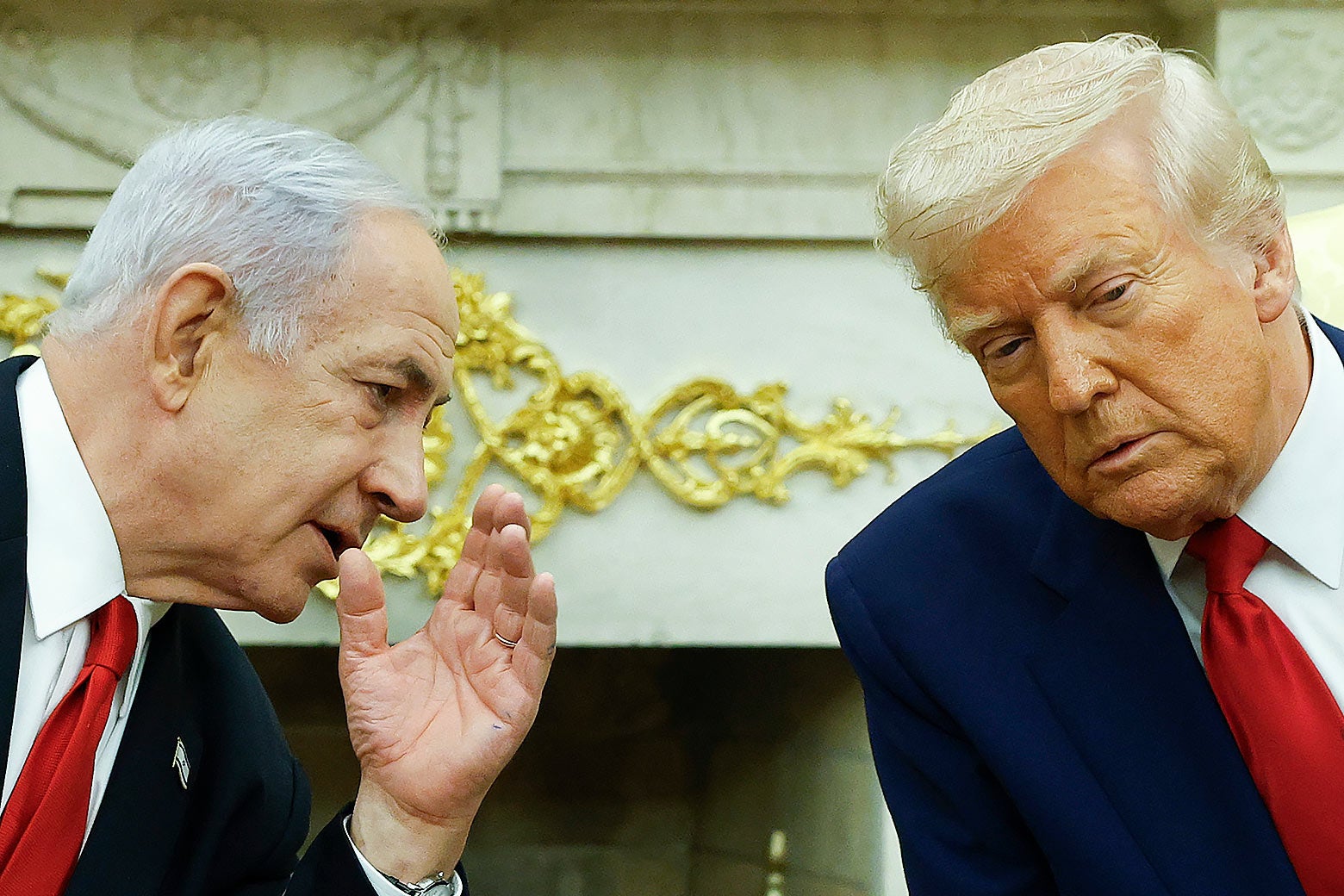
There is some truth to the claim that America’s involvement in Iran is Israel’s fault. Prime Minister Benjamin Netanyahu really did lobby Trump behind the scenes to land what Netanyahu claimed would be a decisive blow against the theocratic regime. But there are a few problems with some anti-war conservatives’ theory that it’s all Israel’s fault. For one thing, it invokes long-standing antisemitic tropes about Jews puppeteering events and ignores that other regional leaders, including Saudi Arabia’s Crown Prince Mohammed bin Salman, were also reportedly egging on a U.S. attack. For another, it skips over the fact that Trump could have chosen to rebuff Israel. Joe Kent, who recently quit his job as Trump’s top counterterrorism official over the war, still couldn’t help excusing the president on his way out the door. “High-ranking Israeli officials and influential members of the American media deployed a misinformation campaign” that “was used to deceive you,” Kent wrote to Trump in his resignation letter. Yet Kent, who also credited Trump for having “understood better than any modern president how to decisively apply military power without getting us drawn into never-ending wars” during his first term, doesn’t address how such a savvy operator let himself get fooled.
Other Iran critics, like the erstwhile Fox News anchor Tucker Carlson, have acknowledged that Trump could and should have known better while still laying most of the blame for America’s involvement in the war on Israel. In an interview this month, Zanny Minton Beddoes, the editor of the Economist, pressed Carlson on that framing. “Israel was certainly pushing for things,” she said, “but I think there is more agency, and therefore more responsibility, with the president of the United States.” Carlson briefly conceded the point—“I wouldn’t disagree”—but quickly returned to his initial premise. “Israel pushed him into this,” he said. “Now, he shouldn’t have gone along with it. He should’ve pushed back. But to pretend that Trump woke up one morning and was like, ‘Well, I think we’re gonna—,’ no, Israel pushed him.” This ignores both that Trump has fantasized about the U.S. attacking Iran since at least the 1980s and that he reportedly decided against doing so in his first term despite Netanyahu’s urgings. When Minton Beddoes asked if Trump had “betrayed” the principles of “America First,” Carlson sounded more wistful than outraged.
And then there are the ones blaming the administration without blaming Trump. Rep. Mike Rogers, who chairs the House Armed Services Committee, left a closed-door briefing with Pentagon officials last week, incensed over what he described as their evasiveness about the war’s goals and scope. “The administration needs to be more forthcoming when they send folks over here,” he vented to reporters. But Rogers also took pains to make it clear that none of his frustrations should be taken as an attack on the president’s vision. As he emphasized in a text message to NBC News, his “criticism has NOTHING to do with Operation Epic Fury,” adding, “I fully support what the administration is doing in Iran.” Talk about splitting hairs.
Rep. Nancy Mace, another Republican who left that Pentagon briefing angry, has been even vaguer about who’s to blame and even more emphatic that it’s definitely not Trump. “President Trump, I want to be very clear, has done an excellent job so far,” Mace told CBS News last week, glazing him as “the strongest president in American history.” But she did blame the Defense Department for not being more forthright about when and how the fighting would end. “I have grave concerns about the Washington war machine getting us into another 20-year-plus endless war,” she said.
The search for scapegoats has led some GOP critics to Sen. Lindsey Graham, the hawkish South Carolina senator they accuse of whispering, Grima Wormtongue–style, into Trump’s ear. Since the first attacks, Graham has barely even bothered to whisper anymore: Last week, he argued on Fox News that U.S. Marines should seize Kharg Island, Iran’s main hub for exporting oil. “We did Iwo Jima, we can do this,” he said, referencing the infamously bloody World War II island battle against Japan. This enthusiasm seems to have made Graham an easy target for his colleagues. Rep. Anna Paulina Luna of Florida went on CNN last week to assure viewers that the president, despite ordering thousands of American soldiers to the Middle East, doesn’t actually want to deploy ground troops in Iran. “I think this administration, specifically the president, has been the first to actually come out in defense of not wanting to put our troops in that type of situation,” Luna said. She instead attacked Graham, accusing him of “acting as if our troops are expendable” and vowing that his “war campaign” would fail. “I absolutely think he should have his Oval Office credentials revoked,” Rep. Kat Cammack of Florida said of Graham. (All that criticism may be getting to him; on Monday, Graham publicly urged Trump to “wind down the war.”)
Not every Iran critic on the right has shown such forbearance. Some America First commentators have blasted Trump by name. So have manosphere podcasters who threw in with MAGA during the previous election but have since been pissing inside the tent. But the overall instinct to treat Trump as a spectator to his presidency rather than its architect does help illuminate how we got here. During his first term, Trump regularly fired top officials for refusing to go along with his whims. Officials in his second, whether out of self-preservation or genuine political alignment, seem much less willing to be bearers of bad news. According to NBC, Trump has been mainlining minuteslong video montages that feature the biggest and baddest U.S. military strikes on Iran, a daily hype reel of “stuff blowing up,” as one official put it. That may help explain why Trump’s assessment of how the war is going—“unbelievably well,” he said Monday in yet another phone call with a reporter—differs so wildly from many Americans’.
Republicans stopping the buck somewhere other than the president’s desk isn’t unique to Iran. Sen. Thom Tillis of North Carolina recently argued on ABC News that Trump has been getting “bad advice” from immigration hard-liners like Stephen Miller and Kristi Noem, who until recently ran the Department of Homeland Security. When ABC’s Jonathan Karl ventured that the president who appointed them to execute the mass-deportation agenda he ran on might deserve some of the blame for how those policies have turned out, Tillis demurred. “I just think that he either has sycophants or cowards around him that need to get out of the way so that we can establish a good, solid, enduring legacy of the president producing good results,” he said.
Even Trump voters who have seen their loved ones detained under the president’s policies have found ways to absolve him. “I don’t blame Trump. I blame Biden,” a California man whose Armenian-Iranian wife was taken to a detention facility last summer told the BBC. A Wisconsin man whose Peruvian wife overstayed her visa blames immigration agents, not the president they work for. “ICE never really has any information, it seems,” he said to Newsweek. Trump, he added, “didn’t create the system, but he does have an opportunity to improve it.” For many of his supporters, the president cannot fail; he can only be failed.
If the Iran war drags on, Republican critics who have refrained from faulting Trump may find that evasion harder to sustain. But for now, the hunt continues for someone else—anyone else—to blame. “As this thing goes south, we need to know exactly who talked him into it and what representations were made to convince the president that this was a good idea,” the “MAGA-adjacent” podcast host Megyn Kelly said on Friday. “Was the president fully briefed about the risks of all of this from the beginning?” Laura Ingraham, one of Trump’s staunchest on-air defenders, wondered aloud on her Fox show on Monday. As Kelly put it, “Now that it’s not only going poorly, but the president’s poll numbers are in a precipitous free fall, we’d love to see some accountability.” Just not for the president.