Sign up for the Slatest to get the most insightful analysis, criticism, and advice out there, delivered to your inbox daily.
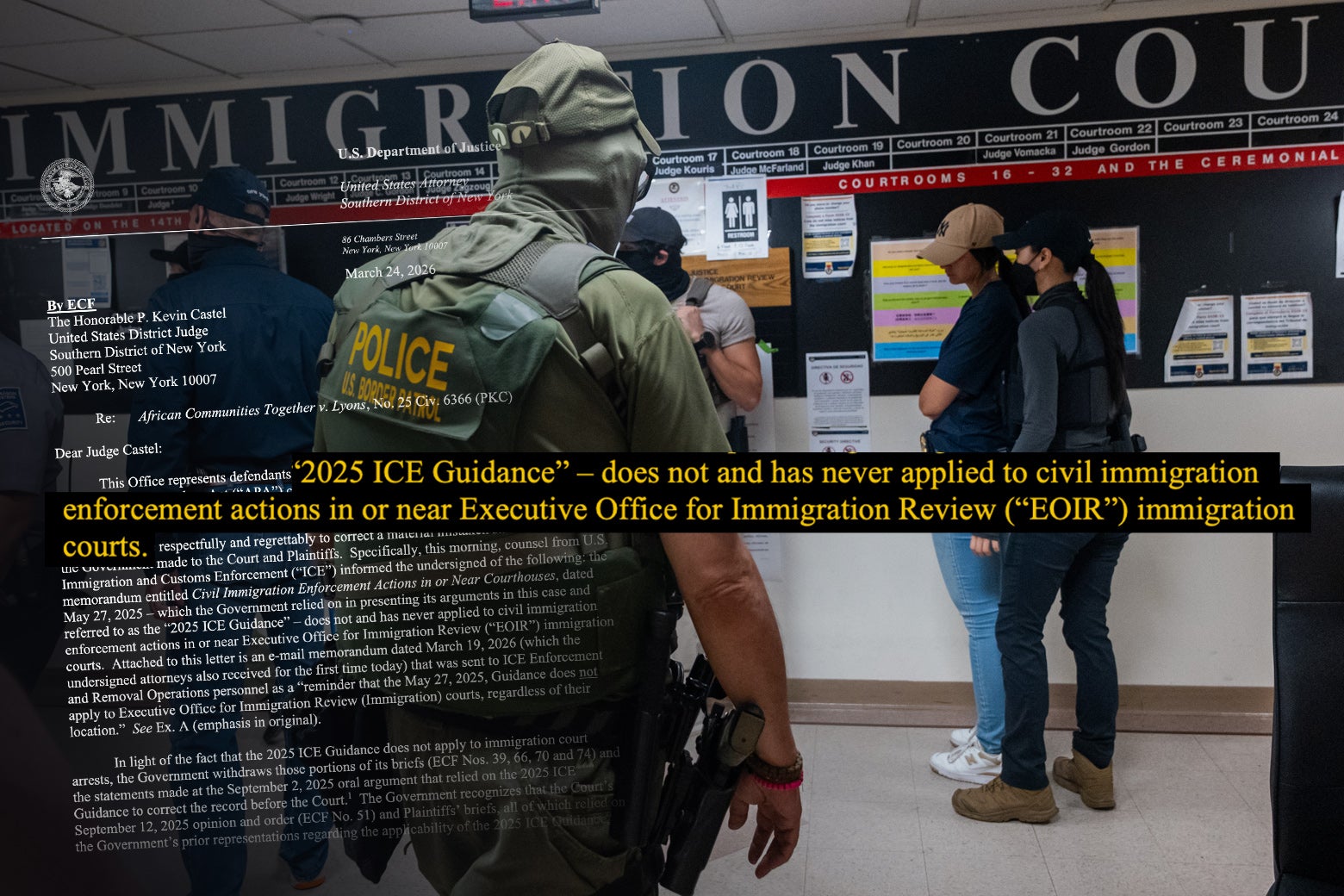
The Department of Justice offered a startling confession to a court on Tuesday, acknowledging that it repeatedly made a “material mistaken statement of fact” while defending Immigration and Customs Enforcement arrests of noncitizens at immigration court. Since August, lawyers at the U.S. attorney’s office for the Southern District of New York had insisted that ICE was complying with an official government policy when it abducted and detained migrants as they left immigration hearings. Now the DOJ admitted that this policy “does not and has never applied” to immigration courts—meaning that its core defense of the agents’ conduct had been fabricated all along.
On this week’s Slate Plus bonus episode of Amicus, co-hosts Dahlia Lithwick and Mark Joseph Stern discussed the Justice Department’s latest catastrophe and its potentially massive impact on ICE’s authority to continue its courthouse arrests. A preview of their conversation, below, has been edited and condensed for clarity.
Dahlia Lithwick: Lately, it feels as if we’re talking every single week about Donald Trump’s Justice Department stepping on a massive rake. Every week it’s a more astonishing screwup, frequently without consequences for any lawyer who admits to error. And one of the reasons we keep hitting this theme, I think, is because the DOJ has historically at least pretended to behave as though it feels a commitment to tell the truth as a representative of the American people. And when that falls away—as it clearly has—judges don’t know how to find the truth. That leads us to this week’s jaw-dropper. How bad do things have to be when DOJ lawyers are telling a court, “My God, we are totally lying”?
Mark Joseph Stern: Really bad! This admission arose from a case challenging ICE’s courthouse arrests specifically in New York City. We’ve all seen the appalling videos of masked agents ambushing and abducting these migrants in the halls of New York’s immigration court as they’re leaving a hearing. Immigration advocates challenge ICE’s policy governing these arrests, arguing, among other things, that it was arbitrary and capricious under the Administrative Procedure Act. The DOJ has long claimed that the policy was not arbitrary but carefully laid out in a May 2025 email about “Courthouse Arrest Guidance and Case Adjudication.” It claimed that ICE agents were carefully following this “reasoned” guidance when arresting noncitizens at immigration court. And U.S. District Judge Kevin Castel sided with the department on these grounds, holding that the courthouse arrests were not unlawfully arbitrary.
Then, on Tuesday, DOJ lawyers admitted to Castel that this alleged guidance about ICE courthouse arrests had never actually existed. It turns out that the Justice Department has been falsely describing a policy that governs arrests at regular courthouses, and that policy explicitly excludes immigration courts. As far as anyone can tell, ICE does not even have clearly articulated procedures governing these ambush-arrests at immigration court! Agents don’t appear to be following any known guidance or constraints when they carry them out. So the department had to withdraw large portions of four different briefs filed in this case, retract multiple statements made at oral arguments, and ask Castel to correct his own opinion repeating this error. It fully blamed ICE for this screwup, by the way, and stated unequivocally that “this regrettable error” had occurred because ICE counsel repeatedly gave DOJ lawyers false information.
The DOJ letter is shocking on its face. But let’s be clear: This is not, by any means, the first time we’ve seen Trump’s Justice Department throw ICE under the bus. In Minnesota, we saw a whole parade of DOJ lawyers telling judges that it was ICE’s fault that the government had failed to comply with court decisions ordering the release of noncitizens who had been illegally detained. I think part of the reason this feels so big and momentous is not only because the lie itself was so egregious and so long-running—and even now sweeps in the judge—but also because it could actually reverse the outcome of the case itself.
Yes. The plaintiffs almost immediately submitted a filing declaring that the “implications of this development are far-reaching” because the department had “withdrawn” its “primary defense to Plaintiffs’ claim that the Immigration Court Arrest Policy is arbitrary and capricious.” They are correct. Remember, the government’s chief argument in favor of these arrests was that they were conducted in accordance with a reasoned policy bolstered by careful analysis and legitimate justifications. Castel endorsed that position when upholding the policy. But the policy never existed in the first place! The DOJ was pointing to different guidance that, by its own terms, did not apply to immigration courthouse arrests!
There are two huge implications that flow from this concession. The first is that ICE’s immigration court arrests were unlawfully arbitrary and capricious all along, because they were never justified with facts or law and adhered to no clear standards. It seems evident at this point that these arrests were haphazard ambushes that followed no consistent rules—ICE just unleashed its agents, with no apparent limits, to go hunt down immigrants leaving their hearings. That’s a quintessential example of an agency action that’s unlawfully arbitrary and capricious.
Then, of course, there’s the problem of ICE lying about its policy to the Justice Department, and the Justice Department lying about that to the court in turn. An agency’s justifications for its actions can’t be post hoc or pretextual. And the DOJ has now basically admitted that any defense ICE devises of these arrests will be made up after the fact, making them illegal under the Administrative Procedure Act. Any justification now will just be an attempt to cover up the reality that these arrests were being done without any known agency guidance in the first place.
Two notes: First, I always have to rush in and say that there are real people who were materially harmed here. They were going to court for hearings they had to attend, then getting scooped up under a pretext that itself turned out to be a lie. The stakes for actual people trying to comply with the law could not be higher. Second, we have to spell out the possible consequences here, since for DOJ lawyers it seems that lying without regret or remorse is clearly not its own punishment anymore. Is anyone ever going to face consequences for this? Because this filing reads to me like the lawyers saying: Hey, it wasn’t our fault—they lied to us, so we lied to you. It’s finger-pointing and shirking responsibility. But a lot of judges have hit the absolute outer boundaries of their tolerance for this.
Quite possibly yes—in part because the DOJ desperately wants to shirk responsibility and push it onto ICE. And Castel appears interested in some accountability. On Thursday, he issued a highly unusual document preservation order in light of the department’s confession. It requires the government to preserve “all communications” in this case, specifically that with the “assigned ICE counsel” who repeatedly gave false information to the DOJ.
That’s a pretty clear sign that Castel wants to investigate this debacle and hold those behind it responsible. He wants to see proof that the DOJ was given inaccurate information by ICE before he lets its lawyers off the hook. And he wants to figure out exactly which ICE lawyer allegedly misled the department so egregiously. We don’t yet know the name of that lawyer, but I suspect we will soon. And that person may be the next government lawyer to face serious consequences for misrepresentations to a court.
I think civil contempt is a real possibility, and criminal contempt may not be off the table. This lie sat at the heart of the case, and Castel relied on it to deny relief while people were being hunted down outside their court hearings by masked agents acting pursuant to no obvious authority. That’s the kind of total breakdown that makes a court look terrible and, as we’ve seen, carries heinous real-world consequences. So, in this instance, because of these unique and idiosyncratic facts, it really is quite possible that somebody’s head is going to roll.