Sign up for the Slatest to get the most insightful analysis, criticism, and advice out there, delivered to your inbox daily.
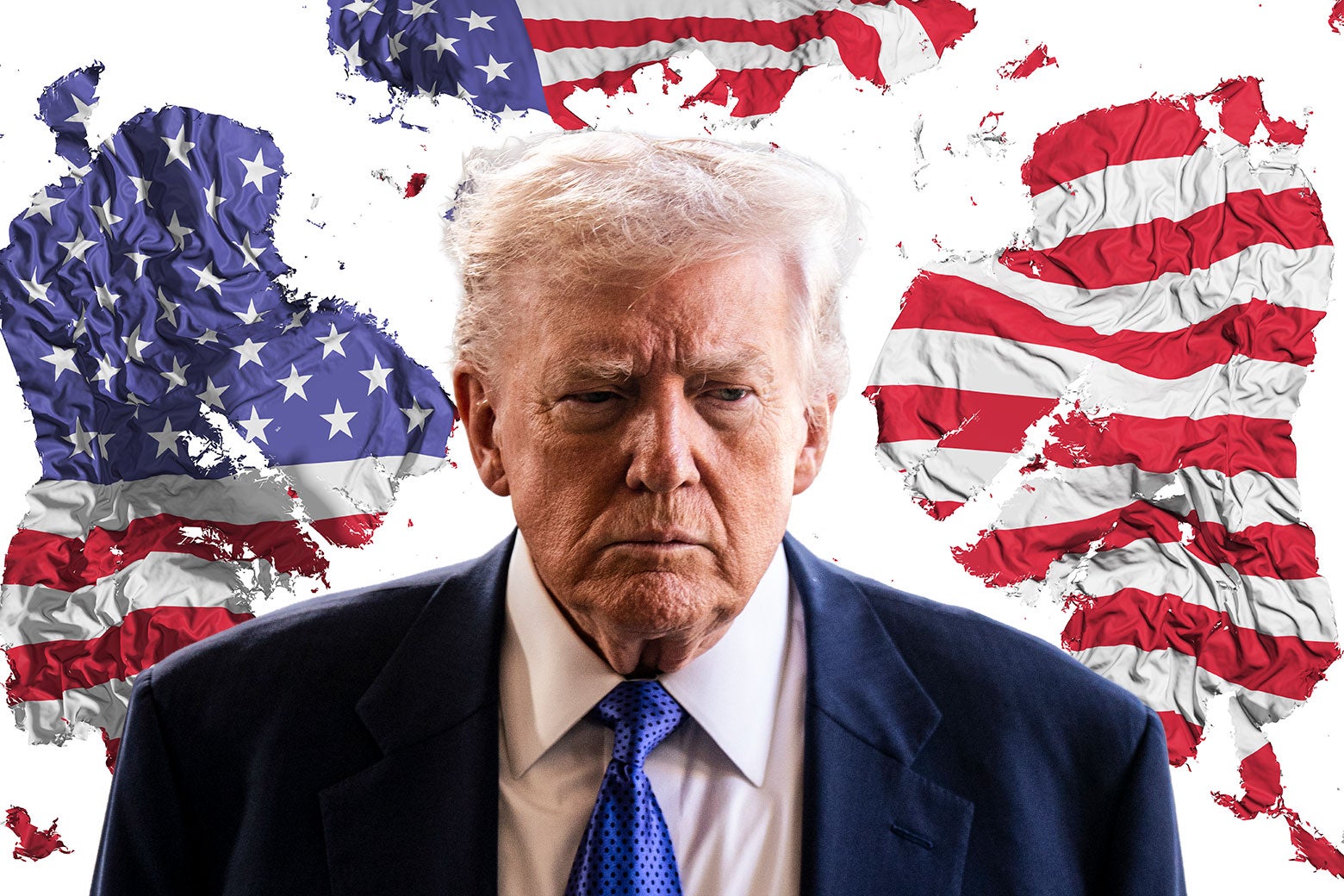
President Donald Trump on Monday escalated his rhetoric against the American electoral system, telling his former FBI deputy director and serial podcaster Dan Bongino that he wants to “nationalize” American elections in 15 “crooked” states. “These people were brought to our country to vote, and they vote illegally,” Trump said. “And it’s amazing the Republicans aren’t tougher on it. The Republicans should say, ‘We want to take over, we should take over the voting in at least 15 places.’ ” I too used to think we should nationalize our elections, though not for the insane reasons Donald Trump offers. It is Trump himself who convinced me that I was wrong.
American elections are hyperdecentralized, as they are run on the state, and mostly county, level. States have ultimate responsibility for voter registration rolls, the kind of machinery used to conduct balloting, the rules for contesting elections, laws prescribing how candidates qualify to appear on the ballot, and much more. Article 1, Section 4 of the Constitution provides that states, through their legislatures, get to set the times, places, and manners of conducting congressional elections, “but the Congress may at any time by Law make or alter such Regulations, except as to the Places of chusing Senators.” Congress sometimes exercises that power to override state rules. For example, a federal statute requires that members of Congress are elected from single-member districts, not from larger districts where multiple members of Congress could be elected.
Given that authority in what is known as the “elections clause” of the Constitution, Congress could do much more to nationalize elections, for example setting uniform rules for voter registration, the approval of voting machinery, and potentially much more. For a long time I thought Congress should use that power to set up a system of national nonpartisan election administration. Indeed, that was the central argument in my 2012 book, The Voting Wars.
If you look around the world at advanced democracies from Australia to Canada, they have an independent governmental body in charge all national elections. The body imposes uniform standards for registration, ballot access, voting machinery, and much more. One can walk into a polling place in Ottawa or Vancouver and have virtually the same experience.
These nonpartisan election administrators are headed by a civil servant or group that does not answer to the government. They and their workers have allegiance to the integrity of the election system, not to any political actor. In contrast, in the United States partisan actors play important roles in our election process, such as secretaries of state who run for office as Democrats or Republicans.
In The Voting Wars, I argued that by joining other advanced democracies we could decrease the amount of partisan fighting and litigation over election rules, increase the competence of election administration, and assure we have a system run with integrity and fair access to voting.
Donald Trump has caused me to abandon this argument. As I wrote in the New York Times last summer, when the president tried to impose his authority over various aspects of American elections via an executive order: “What I had not factored into my thinking was that centralizing power over elections within the federal government could be dangerous in the hands of a president not committed to democratic principles.” At this point, American democracy is too weak and fragile to have centralized power over elections in the hands of a federal government that could be coerced or coopted by a president hell-bent, like Trump, on election subversion. Courts have ruled that parts of Trump’s executive order are unconstitutional because the president has no role to play in the administration of elections.
Trump’s comments on nationalizing elections ironically prove the point that we should not nationalize elections. He apparently wants to target the administration at blue states, doing who-knows-what to make it harder for people to vote for Democrats. He desperately fears a Congress controlled by Democrats that could check his and his administration’s power. As he did in 2020, when he unsuccessfully attempted to overturn the results of the fair presidential election that he lost to Joe Biden, Trump hangs it all on voter fraud. His comments to Bongino about noncitizens voting, just like his comments about mail-in balloting, show Trump as either a liar or delusional. The amount of election fraud of this type is extremely rare. We know it because states, including red ones like Georgia—where Trump’s administration recently raided election offices in a serious threat to the 2026 vote—have gone hunting for fraud and found very little.
The Supreme Court provides another reason for not nationalizing our elections. The court could soon fully embrace that “unitary executive” theory that there can be no exercise of executive power by the federal government that ultimately does not report to the president. (It’s an argument with an exception likely to be applied to the United States Federal Reserve, in order to protect the value of the justices’ 401(k)s.) The unitary executive theory, if adopted, would mean that presidential control over an election body might be constitutionally required. The Trump experience shows why that would be far too risky.
We should now look to states to step up the competence, integrity, and accessibility of their election systems. They serve as the front line against election subversion. Diffusion of power in the states makes it much harder for Trump to mess with the midterm elections. Whether or not the Framers intended it, our messy, decentralized, partly partisan, uneven system of administering elections turns out to be the best bulwark against would-be authoritarian presidents.