Sign up for the Slatest to get the most insightful analysis, criticism, and advice out there, delivered to your inbox daily.
On a quiet street 2 miles north of Boston Common, a triple-decker is being born. These three-family clapboard sugar cubes, thrown up by the tens of thousands around the turn of the 20th century across all New England’s cities, are the backbone of Greater Boston’s working-class housing stock. Quickly built by amateur developers working off a handful of construction drawings, the wood-framed triplexes do the same thing for their neighborhoods today that they did then: provide a decent and affordable stepping stone between the city’s dim, shared quarters and a big house in the ’burbs.
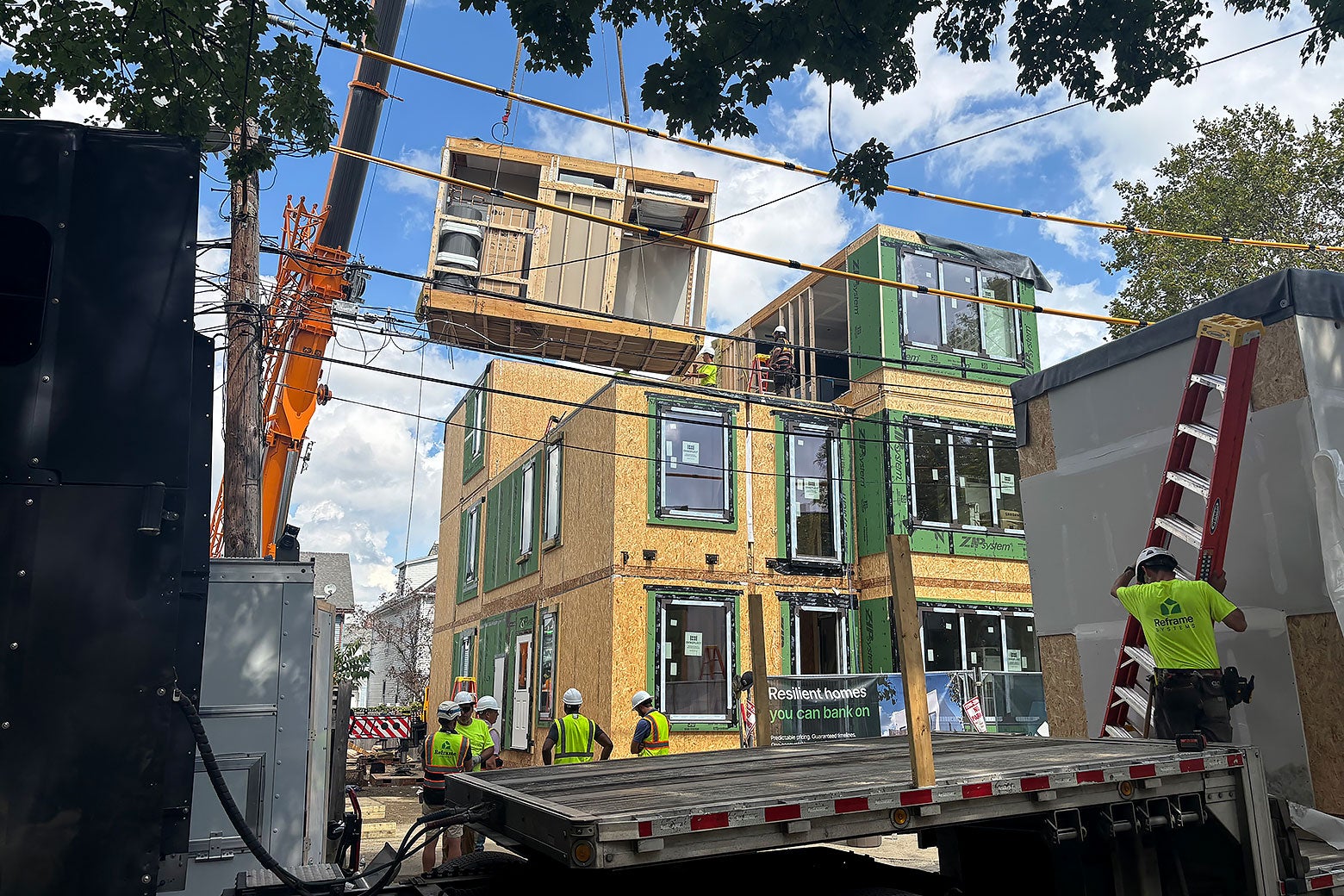
Even in that heyday of urban construction, however, no triple-decker rose as quickly as the one at 13 Gilman Street in Somerville. After the concrete foundation had been poured, its three stories were erected in four days, assembled from a kit of 24 boxes that arrived, toilets and all, on the bed of a truck. The company that makes them, Reframe, is the latest outfit chasing the construction sector’s forever dream, in which buildings are assembled in factories like computers or cars, saving time and money in a field that everyone agrees requires too much of both.
The technical name for this practice is modular construction, which has at times seemed as if it is the undisputed technology of the future. But this time, says Reframe’s founder Vikas Enti, is different. Traditional construction costs are through the roof, fabrication technology is better than ever, and housing prices are a national crisis. The planets are aligned for modular construction. Today, Enti explains, it takes about 150 minutes of human labor to build each square foot of a small multifamily building. He claims that his company can do it in 64. One day, Reframe wants to build at a rate of six minutes per square foot.
Think of it: a triple-decker, from a pile of lumber, pipes, wires, and windows on a factory floor to a finished home in a neighborhood, in one week. This would be an extraordinary development in a city where such projects usually take a year to be completed.
In April, I visited Reframe’s factory at an industrial park in Andover, Massachusetts. Inside, Enti and I watched a robot arm hover over a pile of wooden boards using magnets and a nail gun to assemble them into a wall. It struck me as a complex way to complete a repetitive task, but that is part of Reframe’s pitch: This is not an assembly line churning out a thousand identical widgets.
Enti believes that this conveyor-belt legacy has been holding modular construction back. “The fundamental way in which factory-built homes have worked as an industry is, you build these massive 100,000-to-500,000-square-foot factories that are trying to build one type of product,” he belted over the drone of saws and drills. “We were an extension of the industry building mobile homes, trailer homes. Eventually, that became modular homes, and they brought the same practices, which work well when you’re building a few types of products again and again.”
That method worked well at Levittown, with its identical houses on identical parcels, and continues to serve the nation’s large homebuilders, who might offer a handful of prototypes in each development. And it works for companies churning out trailers. But it doesn’t work for multifamily housing in the city, where each plot is a little different from its neighbor, and rules and codes vary between cities and states. So Reframe’s Andover factory is flexible, and it is small—just 20,000 square feet. Everything there is on wheels or can be picked up by a forklift.
That’s not the only difference between Reframe and an earlier generation of modular housing companies. To be sure, construction technology has also advanced since the great modular boom-and-bust of the ZIRP era, which climaxed with the bankruptcy of Katerra, a much-hyped startup that churned through $2 billion in just six years of operation. The robots are better; the plans are more detailed, so that all the building’s mechanical systems can be installed in the factory and clip together perfectly on-site.
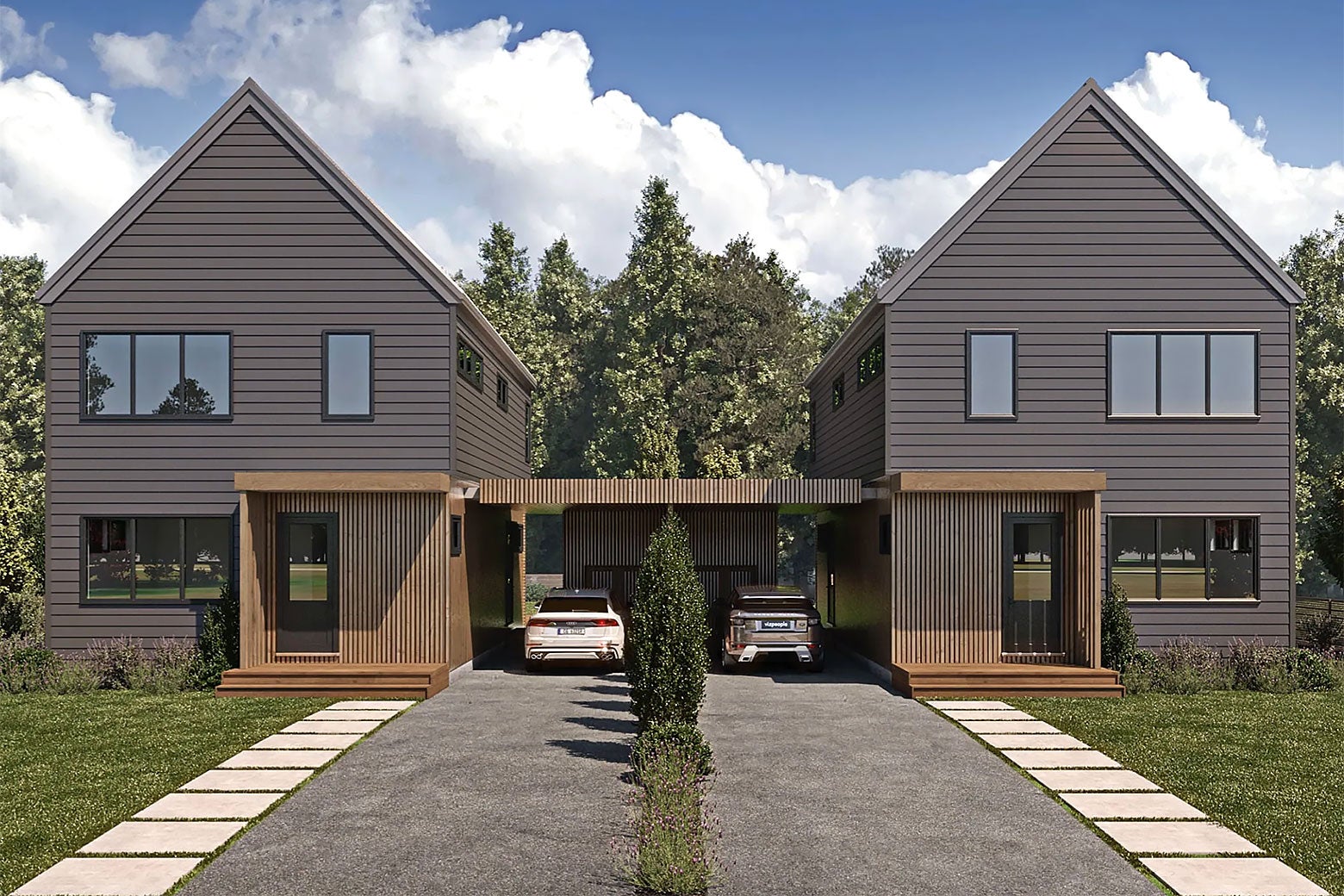
But it’s the small factory that is the key to Reframe’s model. The company needs just $10 to $15 million worth of buildings in the pipeline to justify opening a factory, where larger plants might require more than $100 million in business. Smaller factories can be closer to job sites, which means saving money on transportation costs. This has its own knock-on effect on design: Reframe can design open-walled modules that come together to form larger rooms, knowing that they’ll be subject to less wear and tear on the road—and can be reinforced with reusable, temporary bracing. (This building’s living room modules rolled down Interstate 93 with just two walls.) And small factories can more easily adapt to local variations in building codes. Reframe is hoping to set up a facility in Southern California to help rebuild the neighborhoods of Los Angeles that burned in January.
Companies like Reframe are trying to solve a conundrum scholars call the construction crisis. Although most sectors of the economy have gotten more efficient over time, construction has moved in the opposite direction—construction sites are less productive today than they were 50 years ago. It’s a genuine mystery, and everyone has their own pet theory about what’s to blame.
Put that together with tariffs on materials and a masked federal police force trying to hunt down construction workers, and you can see why new apartments have become so expensive to build even in the few places where they are permitted. Modular housing—as well as similar innovations, like 3D-printed housing—has become a more attractive choice as the cost of building things the old-fashioned way just keeps rising. The speed of operation is particularly attractive when interest rates make it expensive to borrow money for long periods of construction. The in-house, mapped-out pipes and wiring make for an easier install than hacking through a finished on-site structure with teams of subcontractors. And workers are sheltered from freezing winters and dangerously hot days.
But at some point, you still have to leave the controlled environment of the factory. The building on Gilman Street was supposed to be assembled in June, but Somerville spent nearly 10 months delivering the permits. Instead, the trucks with their overside load banners rolled into town in September. On the Tuesday after Labor Day, only one driver showed up, instead of three.
Still, by Friday, Enti and the company’s chief designer, Jillian Wahl, watched as the final rooms rumbled up the narrow street. Workers cut open each module’s white plastic wrap, slipped the steel cables beneath the floorboards, and attached them to a waiting sling from a 200-foot crane. From there, chunks of bedroom and kitchen silently floated over the power lines and were lowered into place, workers twisting the walls into alignment with hanging guidelines like from a hot-air balloon.
The client, an affordable housing executive named Kathy McGilvray, owns the lot and lives next door. When it’s finished, the triple-decker will house her aging parents on the ground floor, her sister on the middle floor, and a rental unit on top. McGilvray knew someone at Reframe and was intrigued on a professional level by the promise of modular construction to open up construction to new workers (like women, part-time caregivers, people with disabilities, or night-shift workers) who are shut out of traditional site work.
But Reframe also gave her a price of $300 per square foot, or $1.2 million for the triplex—less than what she heard from traditional builders and less than the quotes she got to renovate her own existing home. “At that price point, my parents’ unit is $400,000,” she noted—a rare price in a metro area where the median home goes for twice that amount. (That figure does not include the cost of the land, which McGilvray already owned.)
Workers will spend the next few weeks connecting wires and pipes between floors and walls. They will affix the exterior cladding, which could have been damaged by the crane cables if it had been preinstalled. And they will finish the flooring, which must be seamless between modules beyond the project’s half-inch tolerance. “Our feet are so sensitive,” said Enti. He doesn’t want anyone to know that a room was once made up of two separate boxes.
But Laurie, McGilvray’s sister who will live on the second floor, won’t soon forget: She’s been watching her apartment take shape, box by box, from McGilvray’s second-floor balcony next door, as the family group text buzzes with excitement. “OK mom and dad—your bedrooms are here!”
