Sign up for Executive Dysfunction, a weekly newsletter that surfaces under-the-radar stories about what Trump is doing to the law—and how the law is pushing back.
After Wednesday’s oral arguments in this term’s blockbuster birthright citizenship case, one thing became much clearer: The Trump administration’s entire argument hinges on a tendentious two-step, one that the majority of justices do not seem to be buying. It’s important to unpack the absurdity of the semantic case the administration is making to unlock why this effort to rewire all of American society is almost certain to fail. Critically, the administration’s entire case is rebutted by one of the most famous trials in U.S. history, a case that would have been incredibly fresh in the minds of the Framers of the 14th Amendment and the birthright citizenship clause.
About that semantic argument. First, the Trump administration’s theory requires that the 14th Amendment’s use of the word jurisdiction be reinterpreted to mean “allegiance.” Then, allegiance must be defined to exclude the children of temporary visitors and immigrants lacking legal status. Both parts of the argument are wrong, but the claim about limited allegiance is especially wrong in a way that has not been widely addressed.
Within the first moments of his argument before the Supreme Court, U.S. Solicitor General John Sauer asserted that birthright citizenship extends only to children whose parents owe “direct and immediate allegiance” to the United States, a phrase that is not found in the relevant passage of the 14th Amendment. Instead, the first sentence of the amendment plainly states, “All persons born or naturalized in the United States, and subject to the jurisdiction thereof, are citizens of the United States and of the State wherein they reside.” Sauer therefore engaged in his first bit of linguistic legerdemain, telling the court, “ ‘Allegiance’ is what jurisdiction means.”
Even that was not enough to make the case in support of Trump’s executive order. Sauer also had to insist that unauthorized immigrants and temporary visitors owe allegiance to their home countries rather than the U.S., thus removing their children from his tortured definition of jurisdiction.
As it happens, however, there is a direct precedent under U.S. law, well known to the drafters of the 14th Amendment, explaining that the demands of allegiance attach even to temporary or unlawful entrants.
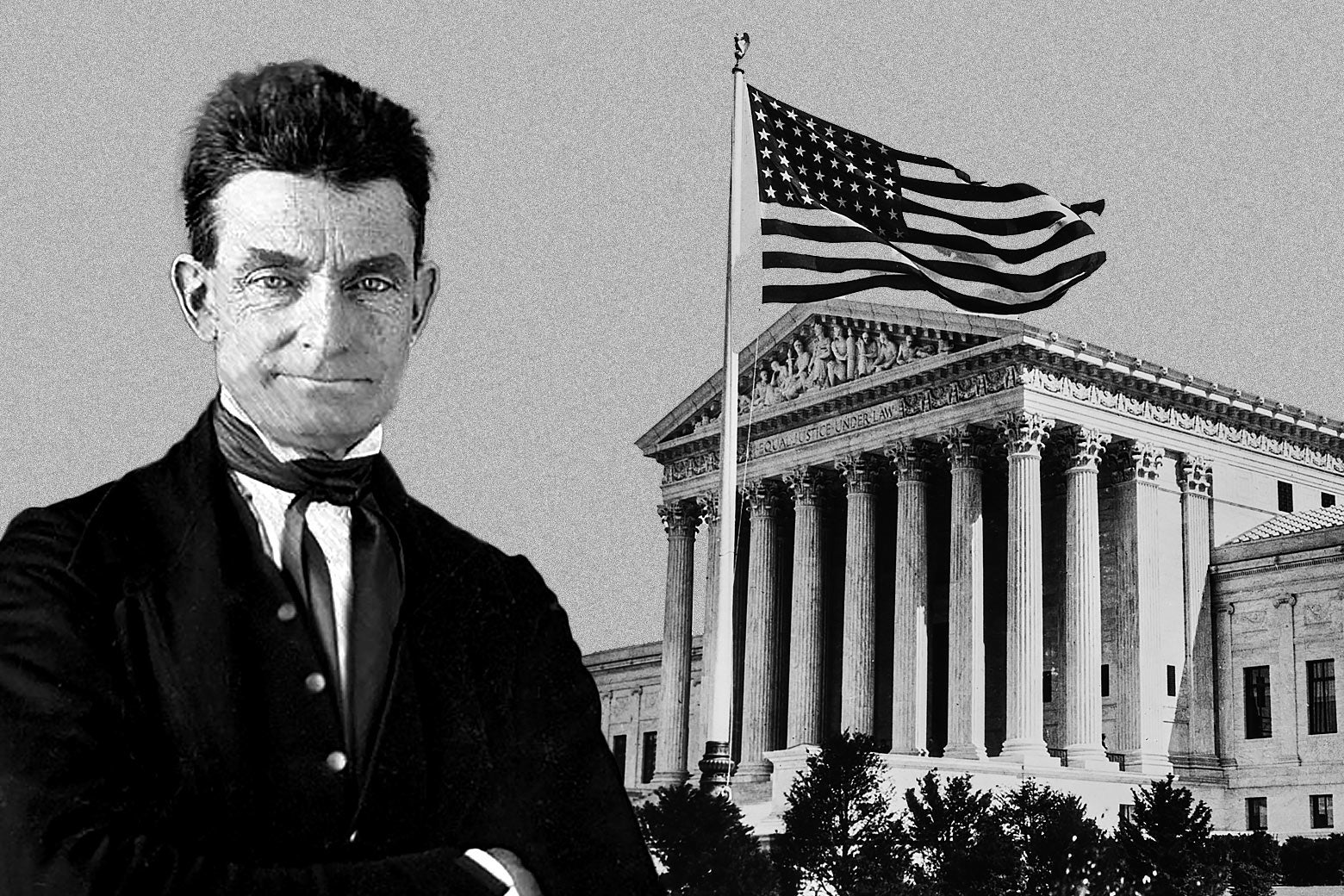
On the night of Oct. 16, 1859, John Brown led a small army of 22 men from Maryland into Virginia, where he intended to free the slaves. His band quickly took control of a federal armory and rifle factory in the sleeping town of Harpers Ferry. The ensuing firefight took the lives of five civilians and one U.S. Marine, as well as 10 of Brown’s men.
Brown himself was captured alive and indicted for the capital crimes of murder, insurrection, and treason against the Commonwealth of Virginia. The latter charge, comprising a breach of allegiance owed to a sovereign or state, was crucial because it was not subject to reprieve or commutation by the governor without consent of the Legislature. Some historians believe that the treason count was intentionally added by the prosecutors to tie the hands of Gov. Henry Wise, who had expressed some admiration for Brown’s courage and integrity.
Seeing virtually no hope of acquittal, Brown’s attorneys were desperate to preserve the possibility of commutation. They repeatedly moved to dismiss the treason count, noting that conviction required a “breach of allegiance, and can be committed by him only who owes allegiance either perpetual or temporary.”
Brown, of course, was neither a citizen nor a resident of Virginia. Indeed, he had entered the commonwealth only a few hours before his raid began, for the purpose of committing unlawful acts. Whatever other crimes he committed, argued his counsel, Brown could not be convicted of treason in the absence of allegiance.
The prosecution responded that Brown’s very presence in Virginia imposed an obligation of temporary allegiance, which he violated by conspiring and attempting to “break down the existing government of the Commonwealth.”
Judge Richard Parker agreed with the prosecutors, holding that treason may be committed “wherever allegiance is due.”
Brown was convicted by the jury on Oct. 31 and hanged on Dec. 2, 1859. In the intervening weeks, he held interviews and wrote letters from his jail cell, denouncing slavery and captivating the country with his dedication and resolve. Ralph Waldo Emerson declared that Brown would “make the gallows as glorious as the cross.” In the words of biographer David Reynolds, Brown’s execution helped “spark” the Civil War.
The John Brown trial cannot completely resolve today’s birthright citizenship controversy—Brown was a citizen of the U.S., although not of Virginia, at a time when state citizenship was primary—but the implications are undeniable. Most importantly, the case demonstrated the concept of temporary allegiance.
At oral argument, Justice Samuel Alito opined that “normally, you would think that a person who is subject to arrest at any time and removal could not establish a domicile,” something that the Trump administration held is essential to allegiance. Alito, however, might as well have been describing Brown, whose unlawful presence—obviously subject to arrest—was sufficient to bring him within allegiance to Virginia.
By the time the 14th Amendment was drafted, in 1866, every member of Congress would have been acutely aware of Brown’s trial, which had been held only seven years earlier. If they considered the history and tradition of allegiance, as the Trump administration maintains, Brown’s execution for treason, based on his imputed allegiance to Virginia, which evidently attached the moment he crossed the state line, would have come immediately to mind. Although it was a state trial court decision, Brown’s case had been intensely covered by the national press, and it was no doubt the most consequential trial in U.S. history until that time.
The Supreme Court has increasingly relied on history and tradition as the key to constitutional meaning. Thus, even if the 14th Amendment’s reference to “jurisdiction” were intended to include an obligation of allegiance—which the challengers of Trump’s executive order do not concede—the Framers would have recognized that temporary presence imposed sufficient allegiance for even a life-and-death decision.