Sign up for the Slatest to get the most insightful analysis, criticism, and advice out there, delivered to your inbox daily.
In January, Florida Rep. Randy Fine made a typically bigoted post on X about his colleague in the House of Representatives, Ilhan Omar. The post was in conversation with a specious right-wing conspiracy alleging that Omar’s net worth had increased, nefariously, through a variety of unspecified means—perhaps cryptically linked back to her Somali heritage. Fine asserted that to “solve all this,” Omar ought to be “denaturalized and deported.” The ugliness of the comment prompted Rick Wilson—former Republican strategist, he of the magnanimous Lincoln Project—to step forward. In earlier eras of discourse, the Lincoln Project attempted to coalesce an anti-Trump movement by appealing to our better angels; brandishing Sorkin-ish platitudes about the Soul of America. (There is a reason the organization name-checks the 16th president.) But Wilson took a much different approach here. Rather than addressing the content of Fine’s character, Wilson homed in on something else: The congressman is very, very fat.
“Hunting you with harpoons and whaleboats would solve all this,” said Wilson, parroting Fine’s diction. Among the responses threaded below Wilson’s retort, one is an edit of promotional materials for a 2011 television adaptation of Moby-Dick. In it, Fine has been photoshopped in place of the whale.
It goes without saying that for a very long time, fat-shaming a politician was previously verboten in the liberal playbook. I also do not possess the wherewithal to cast judgement on whether Fine—who has expressed some genuinely bloodthirsty sentiments about Palestinians—deserves to be bullied in such a way. But what I can say is that, right now, we are in the midst of a marked pivot in the way the Democratic Party interfaces with its opposition. The shift in attitude hasn’t been firmly diagrammed; instead, what’s going on here is mostly subconscious, like a collective unlocking of forbidden territory. There was a period of time in the late 2010s where liberal hostility toward MAGAdom was screened for all potential vectors of transgression, and a seemingly infinite number of potential -isms or -phobias. The philosophy was well-intentioned, but it also solidified the Democrats as the party of pedants (or narcs, or nerds, or rule-followers). Now in the wreckage of the post-Biden era, some liberals have started to alter their approach. If sweeping appeals to our collective empathy have failed to resonate—if the public is not moved by Randy Fine’s intersectional shortcomings—maybe we are better off getting down in the muck.
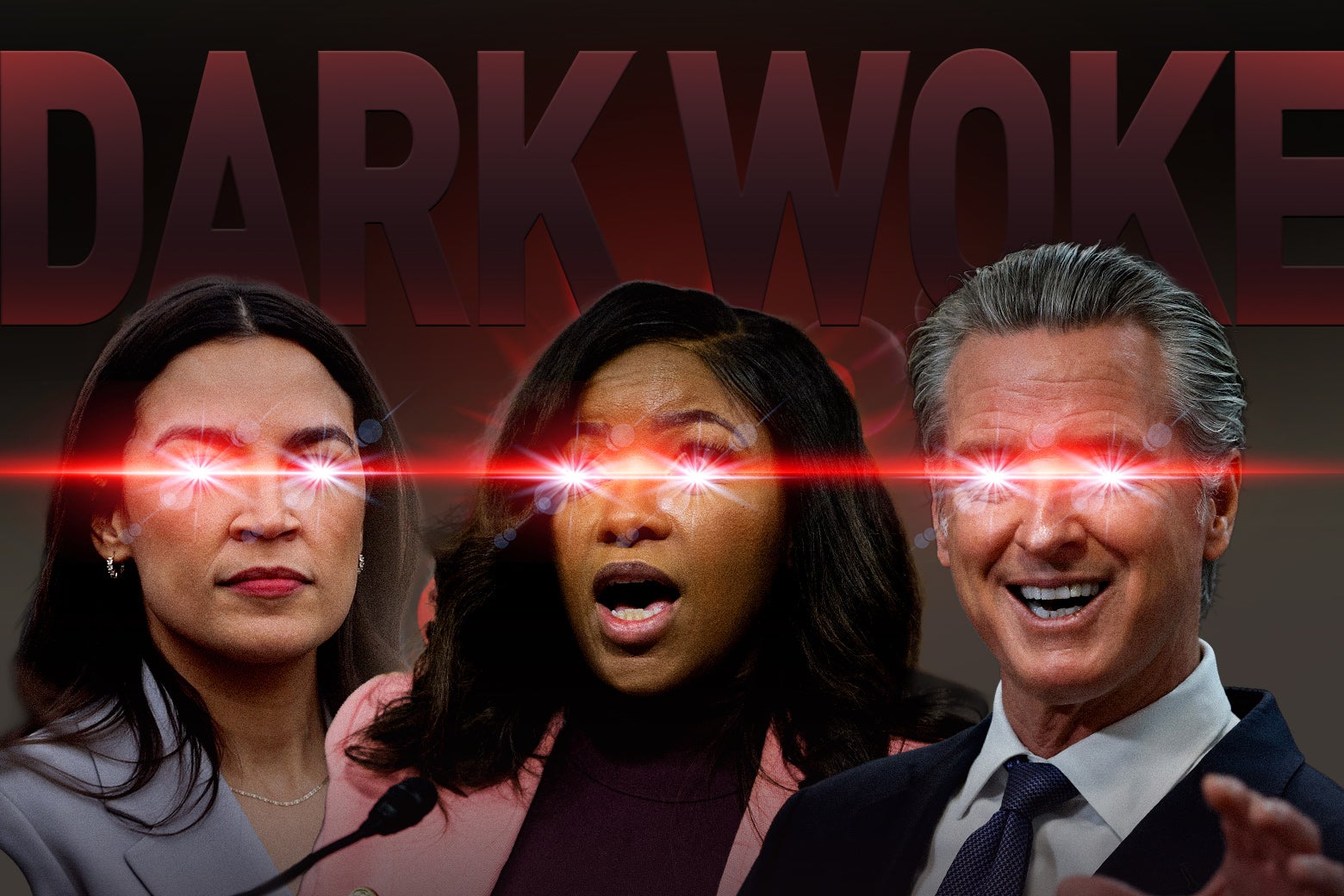
There is no perfect name for this dynamic, but some have begun to refer to it, somewhat facetiously, as “Dark Woke.” In the most basic definition, Dark Woke is a social covenant that allows for liberals to be extra mean to conservatives, by encouraging a style of animus that deliberately crosses the red lines previously established within the progressive orthodoxy. The concept is difficult to articulate, but it’s easily felt. Dark Woke manifests when the liberal pundit Kyle Kulinski tweets out an A.I. rendering of Erika Kirk and J.D. Vance standing side by side at a wedding altar, or when the Democratic Party’s X account accuses Stephen Miller of being cuckolded by Elon Musk, or when Pete Hegseth is dressed down for being a drunk. You can sense it manifesting into corporeal space when Virginia Attorney General Jay Jones crushes the field after fantasizing about the death of MAGA-born children, or when Graham Platner—the guy with the Nazi tattoo—remains competitive for Maine’s Senate seat despite his generational baggage. With the midterms growing nearer, it’s becoming clear that some forces within the Democratic apparatus are betting that Dark Woke can be wielded as an effective electoral strategy. One of the lessons of the current political environment is that Americans crave authenticity. Maybe the only way to consummate that desire is by hitting below the belt.
Dark Woke has only been in the bloodstream for a short amount of time. It initially entered the lexicon in the early weeks of 2025, when both the Democratic Party and any sense of American consensus had been shattered by Donald Trump’s comeback victory. Nobody is exactly sure who originally coined the term, but ground zero, according to the internet historians at KnowYourMeme, might be a post made by Rep. Alexandria Ocasio-Cortez one day before the inauguration. Ocasio-Cortez was replying to LibsofTikTok, a popular X account and one of the more prominent agitators in the MAGA propaganda ecosystem. LibsofTikTok took issue with AOC referring to Trump as a rapist; the congresswoman responded by mimicking the brusque diction of the right. “Oh are you triggered? Cry more,” she wrote, accumulating 17.6 million views in the process.
The candor was refreshing in those confusing times, so much so that one day later, another poster on X theorized that she might have inculcated a new social contract—a “proto Dark Woke”—that liberals could take with them going forward. The poster surmised the texture of the reinvention by positing an instructive question: “Who will the first Democrat to call Republicans retarded be?”
Thus, the Dark Woke thesis was born: Democrats need to open up new persuasive terrain, and by and large, that terrain needs to be unshackled by circumspect language temperance—call it Woke Classic—than ever before. In a way, this conclusion conceded the postelection conclusion of a conservative cultural victory. If the arc of history is indeed tilting rightward, then Dark Woke acknowledges that the Democratic brand had grown too uptight, which must be rectified with a kind of reverse virtue signaling. (It is telling, for instance, that in the weeks before her clapback, Ocasio-Cortez removed the “She/Her” pronouns from her Twitter bio.) Naturally, a number of strivers were early adopters of this brewing vibe shift, branding themselves as heralds for this intrepid age of offense. Chief among those interlopers was Rep. Jasmine Crockett, who is currently running for a Texas Senate seat, and who came to national fame after referring to former Rep. Marjorie Taylor Greene as a “bleach-blonde, bad-built, butch body,” and, later on, the wheelchair-using Gov. Greg Abbott as “Governor Hot Wheels.” Meanwhile, presidential hopeful Gov. Gavin Newsom, who is eternally pliable to whichever way the wind is blowing, popularized California’s redistricting campaign with a Trump-affected shitposting parody. (Newsom has never called Trump the R-word, but he’s easily the odds-on favorite.)
As Dark Woke gained fluency, most pundits concluded that the trend would never amount to anything other than a temper tantrum. “Dark Woke is cringe,” offered New York magazine. “Dark Woke will not work for Democrats,” added the National Review. The fundamentals of the argument were rock solid. For one, Dark Woke is a movement that exists almost entirely online, and it resonates most with highly engaged Democrats rather than with mercurial swing voters who are mostly concerned about the price of eggs. Second, no matter whatever else you say about them, figures like Donald Trump and Stephen Miller are bona fide outsiders. They can claim the mantle of the firebrand, which is forever out of reach for an institutional figure like Newsom.
With all that said, I have been surprised to see certain Dark Woke principles diffuse into the rank-and-file Democratic voting population. The base appears to be demonstrably more bloodthirsty than it ever was during Trump’s first term, almost like they’ve finally been granted an opportunity to satiate a long-unquenched rage, absent any platitudinal hedging. I am reminded of a video that went viral shortly before the November elections, in which a typical MAGA grievance aggregator interviewed a woman holding a cardboard sign at one of those “No Kings” protests. The interviewer is pushing her on the assassination of Charlie Kirk, seeking empathy for the recently departed podcaster. The woman, of course, gives no quarter.
“He was horrible. I’m glad he’s not here,” she said. “He was horrible on the campuses. A horrible person.” The interviewer, taken aback, asked if she’d be happy if the interviewer were assassinated, too.
“Maybe, I’d have to think about it,” she replied.
What was it that Michelle Obama said during Hillary Clinton’s coronation? “When they go low, we go high.” Voicing a sentiment like that today might get you booed out of the building. And yet, it needs to be acknowledged that according to MAGA media enterprises, liberal discourse has long been vulgar and hateful. Given the chance, the thinking went, they’d round up all of us “America First” patriots in a Soviet-style purge.
The right’s narrative of a bloodthirsty Democratic Party was, well, at odds with party voters’ 2020 decision to bypass a host of progressive options in favor of the rigidly moderate Joe Biden. But the right isn’t wrong about the long-standing loathing of Trump and everything he represents. I mean, one of the first controversies that surfaced after Trump’s initial ascension in 2016 centered around a photo shoot starring Kathy Griffin. She was posing with a prop of the president’s severed head.
But if you asked me why the Dark Woke opposition during Trump’s second term feels different, I’d assert that, while opposition to Trump during his first term was intense, it was also championed by a murderers’ row of grifters and mediocrities; Michael Avenatti, Andrew Cuomo, the Krassenstein brothers, and those same Lincoln Project guys. Ultimately, the loudest of those voices wielded anti-Trump advocacy as a vehicle for their own enrichment, buttressing presidential campaigns, podcast networks, and thrice-weekly Substacks. It worked, Trump did lose in 2020, but the #Resistance was left with a distinct careerist sheen—buoyed by discretionary restraint—lacking the organic force of, say, a soul-buckling fat joke. As The Outline saliently noted in 2019, this disposition seemed to suggest a holier-than-thou elitism. Calling the president a Cheeto was fine, but making fun of Charlie Kirk was not.
But the means of engagement have been altered, maybe permanently, in the tumult of this current political armageddon. MAGAdom is the party in power; naturally, their opponents are choosing to meet them on the battlefield of their choosing. With that said, I do think some surprising sensitivities within the conservative doctrine have come into view, as the movement sublimates into the uncomfortable posture of the establishment. This was most clear during Immigration and Customs Enforcement’s occupation of Minnesota, after masked agents killed Renee Good and Alex Pretti. Among the many faulty narratives that orbited out of the government, one asked us to consider the mental anguish suffered by these dispatched officers. J.D. Vance himself wondered if his roving band of goons would “feel safe” during the aftermath of those murders. Put on the defensive, Vance and his contemporaries have occasionally fallen back on the diction of the soft, snowflake liberalism they claim to hate. But in an ironic twist, the right has already provided the perfect blueprint to nullify shrill emotional terrorism. To quote AOC, “Cry more.”
Of course, this gets us back to the central anxiety of the moment. Is Dark Woke good? For the soul? For the body? For the future? I was socialized in the crucible of millennial progressivism. I have long believed that it is unkind to make fun of someone for their weight, that I should prune the slurs out of my lexicon, that I should refrain from laughing at the misfortune of those who have recently met a tragic end. Dark Woke asks us to make special exceptions for the aberrant forces in our midst—to bully insecurities, to express our anger viscerally—because their sins are great enough to eclipse the worst things any of us can say about them. After all, it is difficult to conflate language with violence when the violence itself has become so plainly visible. It remains to be seen if Dark Woke can grow potent enough to outweigh the sun-blotting forces of Dark MAGA, or if fickle centrists find all of this liberal rage more alienating than relatable. But I—and millions of other Americans—do know what it feels like to be alive in 2026. I never want to go high ever again.