Sign up for the Slatest to get the most insightful analysis, criticism, and advice out there, delivered to your inbox daily.
In a functional sense, I’m an any-pronouns person. At my parents’ house, I will always be she/her. With friends, I’m a they/them. And at the Atlantic Terminal Mall in Brooklyn, I’m a he/him teenager who must be escorted out of Sephora for shopping without an adult present. (I haven’t been a teen since the 2010s, so this is how I found out that malls are increasingly banning young people. Showing Brooklyn’s own Paul Blart my “Sex: F” driver’s license, which features a pre-transition ID photo, did not improve the situation.) This mixed bag is a constant reminder: Gender is in the eye of the beholder.
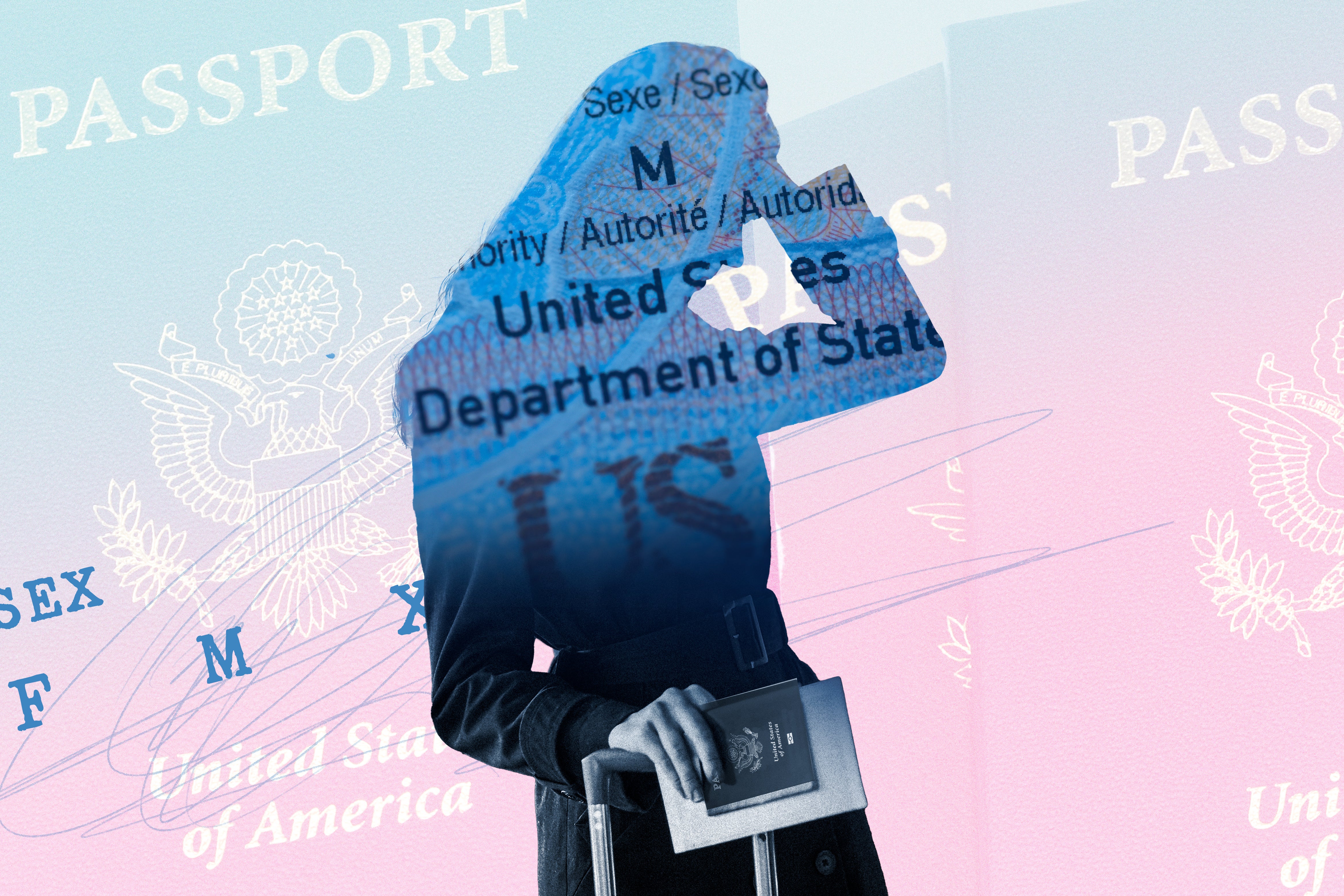
My gender bag has been especially mixed at the airport in recent years. To Transportation Security Administration agents and passport control officers, I’ve looked like a guy who stole some girl’s ID. And the only thing stopping me from joining the crimes-in-the-sky club, I guess, was the “Sex: F” marker that confirmed their suspicions. It’s never been too extreme, but I’ve had my share of airport confrontations—been sent out of security lines, tried my luck yelling “I’M TRANSGENDER” at more than a few agents. Luckily, I was among those who were able to take advantage of the brief window of time between July and November of last year when a federal judge blocked the Trump administration from enforcing its policy requiring gender markers on government IDs to match a person’s sex assigned “at conception.” I secured an “M” passport just before the Supreme Court overruled the injunction, hoping to never experience another gender interrogation at an airport again.
This ID policy is just one of many concurrent anti-trans assaults enacted or worsened by the Trump administration, including forcefully detransitioning incarcerated people, transferring trans women into men’s prisons, and plotting to revoke Medicaid funding for any hospital that provides gender-affirming care to trans youth. Without question, there are more existential threats to trans life than incorrect gender markers on IDs. Still, the passport situation sucks, especially since—crucially, and somewhat shockingly—passports have long been the easiest form of government identification for trans people to update.
By permitting the ban on gender-marker changes to take effect, even as it faces legal challenges, SCOTUS is facilitating the reversal of decades-old State Department practice. Starting in 1992, trans people could submit proof of surgery to change the gender markers on their passports, and in 2010 the surgical requirement was lifted. By 2022, the State Department allowed for self-attestation. After decades of allowance, how did this small matter of administrative policy—seemingly located outside the ginned-up panic over trans kids and athletes—find itself a major focus of the executive orders Trump issued against “gender ideology” on his very first day in office?
Let’s start at the beginning, which, in the case of the passport gender marker, wasn’t so long ago. Even though American passports are as old as the United States—consular officials issued them during the Revolutionary War—gender markers didn’t appear on the document until 200 years later. In 1977, the State Department added the category amid a growing moral panic about gender. This history was spotlighted in 2018, when the State Department filed a brief memo tracing the trajectory of the gender marker on passports while defending itself in a lawsuit brought by Dana Zzyym, an intersex person seeking an “X” gender marker.
As outlined in the memo, in 1968, the International Civil Aviation Organization assembled a panel of experts to suggest standard information to include on passports. Four years later, ICAO recommended passports include a sex marker because “the rise in the early 1970s of unisex attire and hairstyles” meant “photographs had become a less reliable means for ascertaining a traveler’s sex.” Northeastern professor Craig Robertson, author of The Passport in America: The History of the Document, says he sometimes jokes that David Bowie caused M/F sex markers to be added to the passport. In accordance with ICAO guidance, the State Department issued a new passport book including a gender marker in 1977.
Attributing this inclusion to a rise in androgynous fashion alone, though, is a little too credulous. The year ICAO first recommended the inclusion of a sex marker on passports, 1972, was also the year the infamous anti-feminist Phyllis Schlafly began her campaign against the Equal Rights Amendment, arguing that it would eliminate sexual difference between men and women altogether and open the door to an all-out assault on women. There would be nothing stopping men from forcing their way into women’s bathrooms, Schlafly warned.
Five years later, when the State Department issued the first passport book including a gender marker, anti-gay activist Anita Bryant kickstarted her infamous Save the Children crusade against antidiscrimination laws. After successfully defeating a local ordinance in Miami-Dade County, Florida, that prevented discrimination in housing and employment based on sexuality, Bryant embarked on a nationwide tour to battle against similar protections. Chief among Bryant’s concerns was that antidiscrimination laws would force gayness into schools. Toward the end of the year, a gay guy named Thom Higgins pied her in the face at one of her events in Iowa. Higgins was part of a group of militant queers who had put bigots on notice by declaring 1977 “the year of the pie”—a memorable expression of the intensifying sociopolitical battle over sex and gender, and one that certainly transcended the realm of unisex fashion.
It’s all terribly familiar, of course. (Besides the unfortunate lack of pie activism in the current iteration of the panic.) And reflecting on anti-queer revanchism by locating precedent in the likes of Schlafly and Bryant is nothing new. But mentions of the 1977 introduction of the gender marker on passports often accept the State Department at its word, without further interrogation. And sure, maybe by the 1970s it was harder to tell men and women apart with just a picture. But in my view, it’s no coincidence that the gender marker was introduced at a time when the country was embroiled in a constitutional and legal reckoning with the very meaning of sexual difference, spurred in part by attempts to codify antidiscrimination protections.
Given this history, it might be surprising to recall that trans people were able to update the gender markers on their passports a full 23 years before the legalization of same-sex marriage. Especially to those who falsely historicize transness as a trend tacked onto the gay rights movement in the 2010s, rather than recognizing gender transgression as a phenomenon as old as the imposition of gender itself.
Paisley Currah, author of Sex Is as Sex Does, which examines the history of gender classification in the United States, argues that this chronology has little to do with how relatively pro-gay or pro-trans we’ve been as a culture. Instead, it’s about the specific functions of different governing institutions. Gender markers that don’t stir up confusion in security agents are more amenable to the project of identifying bodies as they move through space—so that the government can do things like decide who deserves to live in this country and who should be deported, who should be targeted by law enforcement for arrest and imprisonment, and who should have their civil liberties revoked as subjects of ongoing surveillance. An “F on the driver’s license of a balding, bearded man (me) hinders the public and private protectors of the security state,” Currah writes. Marriage, meanwhile, is about the distribution of property and resources, often in arrangements that are useful to the government—a very different kind of project.
The Trump administration reversing decades-old State Department policy, then, does not necessarily further its capacities for border security or government surveillance. The motivation for the policy can only be understood in its full context—among the deluge of other executive orders against “gender ideology”—that aim to expel trans people from public life and use us as endless proxies for other political battles. On its own, the gender-marker policy will help target trans people in places that call for ID—at the airport, yes, but also in government buildings, at financial institutions, at the pharmacy. Taken as one part of a larger whole, the policy makes transness and trans people suspect everywhere—in massive sports arenas and mundane workplaces alike, at public schools and the doctor’s office. The presence of trans people in these places serves as pretext for the government to reshape them for everyone, in any way (deciding what kids are taught; revoking federal funding for critical public goods like health care) that meets the political needs and objectives of those drumming up the panic.
The current battle over gender markers on passports has its roots in the gender panic of the 1970s, when the category was first established. The 1977 introduction of the gender marker was an attempt to reinscribe sexual difference in the letter of the law and administrative policy. The recent prohibition on changing it goes further—sexual difference isn’t just real, it’s innate and unchanging. Any challenge to sex’s immutability—a challenge that takes human form in transness, in people like me—simply does not belong in society.
I had the chance to use my newly issued “M” passport while traveling for the holidays at the end of last year. During that trip, my dad reminded me that it was actually the second “M” passport I had in my life; the first was issued to me after a bureaucrat took a look at my picture as a boyish child and felt compelled to update the gender marker without being asked to do so.
Gender is in the eye of the beholder.
On my way home from the trip, I advanced sleepily through a passport control line in Madrid. I noticed that the agent I’d appear in front of was quite chatty. When it was my turn, though, he didn’t say much. He looked at me, stamped my passport silently, and then went to hand it back. But at the last second, he pulled it away from my outstretched hand—looking down at the document and then back at me.
Every past instance of airport interrogation flashed through my mind.
After a beat, the agent smiled and winked, and handed the passport to me. He was just joking.