Sign up for the Slatest to get the most insightful analysis, criticism, and advice out there, delivered to your inbox daily.
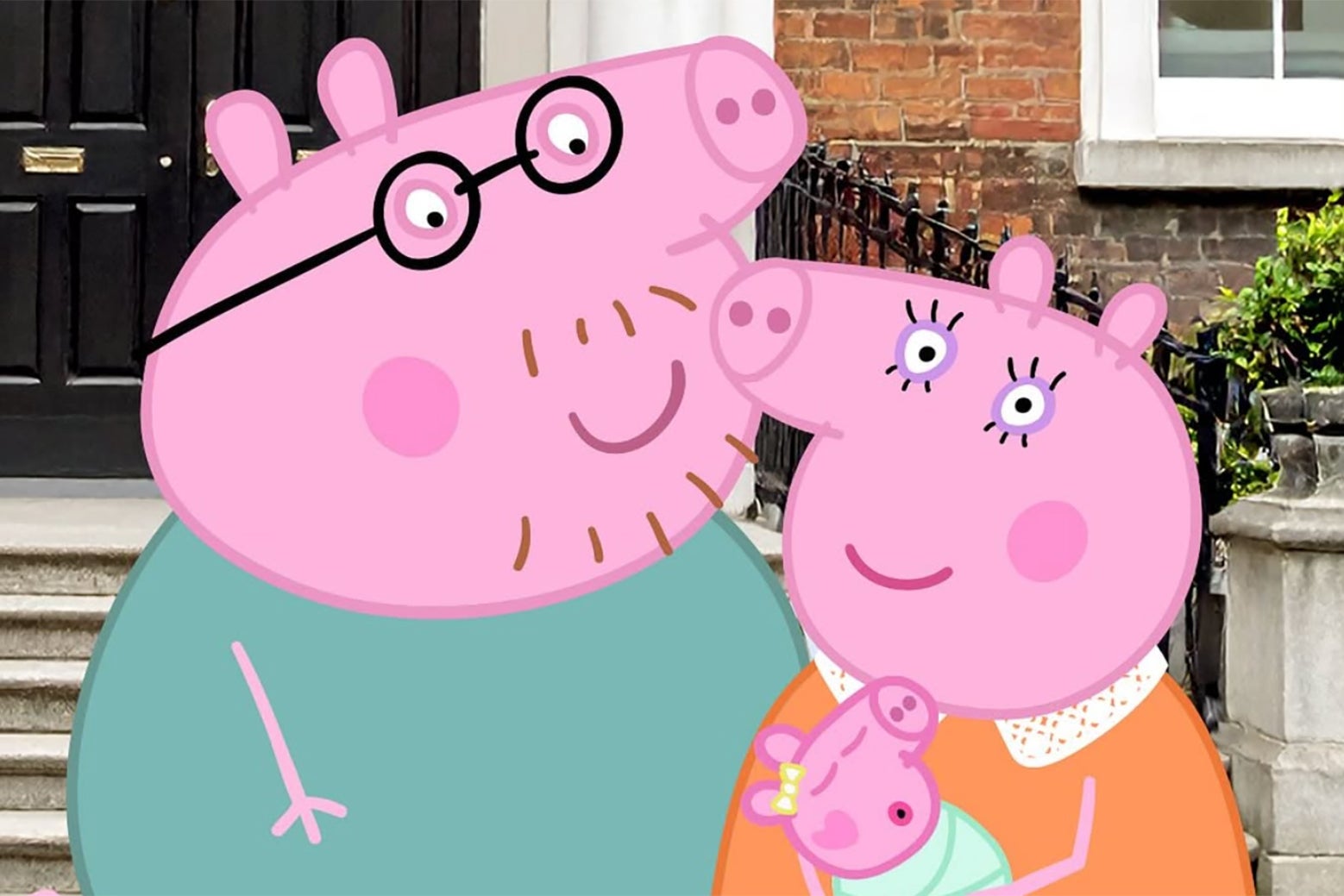
There is something very strange going on in the U.K. right now: In a spectacularly gauche fashion this past Tuesday, Good Morning Britain announced that Mummy Pig—the devoted mother and matriarch from the long-running animated children’s TV series Peppa Pig—had given birth to her third child, Evie. This event, if we can call it one in the first place given that Mummy Pig is an animated cartoon, has gotten more traction than any celebrity birth I can remember, except the birth of Prince George (the future king). Even then, the BBC, People, the Independent, the Daily Mail, the Guardian, and the Evening Standard have all reported on Evie’s arrival as if it were real; in an interview with Hello!, Daddy Pig coos that: “Mummy pig was AMAZING, and she brought our new baby girl into the world. What a miracle that is!” A town crier was also procured to make a separate announcement. I can only assume this took place in Peppa Pig World—an amusement park that, much to my chagrin, is supposedly located only a short drive away from where I grew up.
Since news of the Pig family’s latest addition first broke, I’ve not been able to stop thinking about the pink swines. This is likely because the news, as above, has been shared with almost every major media outlet in the U.K. like it’s real—not just Evie’s birth, but every stage of Mummy Pig’s pregnancy. Among the myriad articles about it, there have been several other strange publicity stunts including a gender reveal at Battersea Power Station and endless interviews. Mummy Pig herself has even appeared on Kylie Kelce’s podcast. It’s all very odd.
Why and how has this bit gone so far? Having spent the past five years or so researching reproductive rights in fiction, I suspect this is some kind of pro-life, pronatalist propaganda for Brits. I’m not alone—this is the resounding conclusion among my friends and anyone I’ve spoken to about it. Interestingly Peppa Pig is produced by Hasbro Entertainment, which may explain why they have an unlimited PR budget.
Perhaps you think I’m being a little conspiratorial here, but I would point to the U.S. as a master class example of what dark future the Mummy Pig press tour forebodes. Population panic has always haunted cultural conservatism—across both sides of the Atlantic, anxieties around “birth rate crises” recall the language of far-right “white replacement” fears. In real time, Donald Trump’s reelection has jettisoned any pretense of coyness around this: There are the mass deportations and the continued attacks on abortion access, and Elon Musk, the technophile who has talked privately about wanting to sire “legion-level” numbers of children, has claimed that birth control may lead to the “collapse” of civilization. The sentiments are now making their way across the pond.
The agitprop exploits of Mummy Pig’s pregnancy aren’t even the first time a cutesy cartoon animal has been used like this here. It’s not even the first time this year: When Paddington Bear was given a passport by the Home Office in February, Imogen West-Knights rightly asked, “Why—for what propagandic purpose—are we giving a fictional bear a passport while asylum-seekers drown in the English Channel?” Since then, we have seen Prime Minister Keir Starmer’s promise earlier this month to “take back control of our borders.” This is very different from the Labour leader’s views in 2020, when he claimed that “we welcome migrants, we don’t scapegoat them” and that we must “make the case for the benefits of migration, the benefits of free movement.” If Paddington can be used to peddle fables of the Good Immigrant, loved and welcomed into our country with open arms, Mummy Pig has just become the new poster girl for Good Mothers everywhere.
Evie’s birth has also coincided with some very alarming culture shifts in the U.K.—need I remind you, cartoons don’t have menstrual cycles and the porcine parents could have theoretically had their third baby whenever their animators fancied. (In fact, when Mummy Pig announced her pregnancy back in February, she told viewers she was “due in the summer” but the baby seems to have arrived a little early. Suspiciously, there’s no mention of this in any of the birth announcements.) In April, as the U.K.’s Supreme Court ruled that the legal definition of a woman is based on biological sex (much to the joy of transphobes everywhere), supposedly liberal Starmer called it “a welcome step forward”. (In 2022, he told the Times that “trans women are women” under the letter of the law.) Just nine days after the ruling, Battersea Power Station hosted its elaborate gender reveal for Mummy Pig’s fetus by lighting up the two chimneys pink, covered by a BBC article titled “The Gender Reveal You Have All Been Waiting For.” I should caveat two things here: The first is that not a single person, adult or child, I know personally cared about this at all. The second is that big gender reveal parties aren’t really the done thing in the U.K.; to have one this size and scale now feels very sinister to me, and that’s setting aside the fact that this is for an imaginary pig. It’s as if Peppa Pig the brand has been quietly drafted into an attempted national spectacle of gender essentialism.
I wouldn’t call Mummy Pig a tradwife by any means, but it bears noting that the Peppa Pig World website doesn’t deign to list any paternal duties under the FAQ: “What is Daddy Pig’s job?” Mummy Pig, meanwhile, is restricted to a vague WFH role and “of course, [looking] after her little piggies, Peppa and George.” I think this dissension in how the two pigs are discussed matters: While it valorizes the mother’s labor as natural, instinctive, and duty-bound, Daddy Pig becomes a kind of comic auxiliary to the nuclear unit. We shouldn’t take this kind of narrative lightly, especially when it’s smuggled in under the guise of harmless family fun, and when falling birth rates have been co-opted to enact unspeakable cruelty on pregnant people in the name of “saving civilization” as Musk would have it.
Meanwhile in the U.K., medical leaders are calling for urgent reform of abortion laws in England and Wales, following an “unprecedented” rise in recent prosecutions of women and girls for ending their own pregnancies. The reason for this apparent increase is not yet clear, but campaigners point to a growing climate of surveillance and a legal framework that remains dangerously open to interpretation. Abortion in Britain is still governed by a patchwork of exceptions to criminal law: The 1929 Act first enshrined the idea of fetal “viability” at 28 weeks, defined as the point a fetus could supposedly survive outside the womb. This threshold was inherited by the 1967 Abortion Act and later lowered to 24 weeks under the 1990 Human Fertilisation and Embryology Act. Today, abortion is still only lawful under the 1967 Act if it meets specific conditions: It must take place before 24 weeks, be authorized by two doctors, and be justified on medical or social grounds. Some practitioners bend these rules; others enforce them strictly. But the law has created space for confusion and now, prosecution.
The end goal of these attacks on trans, migrant, and reproductive rights seems to be the reestablishment of a rigid, state-sanctioned ideal of the family: cis, heterosexual, white, and obedient. The royal family is the crown jewel of this fantasy, tasked not only with upholding British values but quite literally breeding it. Mummy Pig “had” Evie in the same private hospital where Will and Kate also had their kids, another troubling sign. We all know that our National Health Service is in dire straits: Midwives are leaving the profession in record numbers, maternity wards are dangerously understaffed, and access to reproductive health care is increasingly patchy and politicized. That Mummy Pig went private instead of championing the NHS feels like a pointed slight against the overburdened public services that so many parents depend on.
At a time when real people’s bodies and choices are under relentless assault, this spectacle around a cartoon pregnancy feels less like innocent entertainment and more like a cynical, state-backed endorsement of dutiful motherhood to young Peppa Pig fans. If you wanted to make reactionary politics look like harmless fun, what better vehicle than a talking hog in a dress? At least the adults are catching on.