In the fall of 1968, Texas-born Jeannie C. Riley became the first woman to get a single to the top of both the Hot 100 pop chart and the Hot Country Singles chart: “Harper Valley PTA,” a sassy story-song about a widowed mother feeling herself—scandalizing her hometown in miniskirts and clapping back at her detractors, the “Harper Valley hypocrites.” While it’s tempting to call Riley’s debut single and biggest hit a country “crossover,” it didn’t really cross over. It broke at pop and country radio stations virtually simultaneously—in fact, it got to No. 1 on the Hot 100 a little faster than the Country chart and even held off the Beatles’ “Hey Jude” from No. 1 for a week. “Harper Valley PTA” was a cross-cultural sensation, a twangy Southern take on the counterculture. From the jump, it was as much pop as country.
Here’s the thing: When you walk through the history of pop-and-country double–No. 1s, and focus on the tiny handful of these hits by women, there are similar asterisks on pretty much all of them. Almost none could be called straight-up country records, and the ones that do qualify are duets.
The list is so short, I can run it down here. After “Harper Valley PTA,” it took more than a decade for another country woman to top the Hot 100, when Dolly Parton’s “9 to 5” rang the bell in early 1981. As great as that song is, “9 to 5” was the theme to a blockbuster 1980 movie co-starring Parton, and it’s mostly pop with a sprinkling of disco; Parton’s drawl is nearly the only country thing about it. The same goes, more or less, for Parton’s other pop-and-country No. 1, the 1983 Kenny Rogers duet “Islands in the Stream,” written by the Bee Gees. Taylor Swift has two Hot 100–plus–Hot Country toppers, but 2012’s pop-rock, twang-free “We Are Never Ever Getting Back Together” really shouldn’t have been on the Country chart, and her 2021 reboot of “All Too Well” only qualified for the Country chart as a relic of Swift’s earlier career, now benefiting from her subsequent pop megastardom. Kacey Musgraves’ 2023 ballad “I Remember Everything” is solidly country in instrumentation and lyrical approach—but it only got to No. 1 on the Hot 100 because her duet partner and the song’s lead artist, Zach Bryan, was then at the peak of his popularity. The same goes for Tate McRae’s fluke 2025 double-topper “What I Want,” on which she was the featured artist to country kingpin Morgan Wallen. In between those duets, Beyoncé’s superlative two-step “Texas Hold ’Em” topped both charts because she’s Beyoncé, full stop; and I’ve already explained the strange data circumstances that made Bey’s hit a fluke Country No. 1.
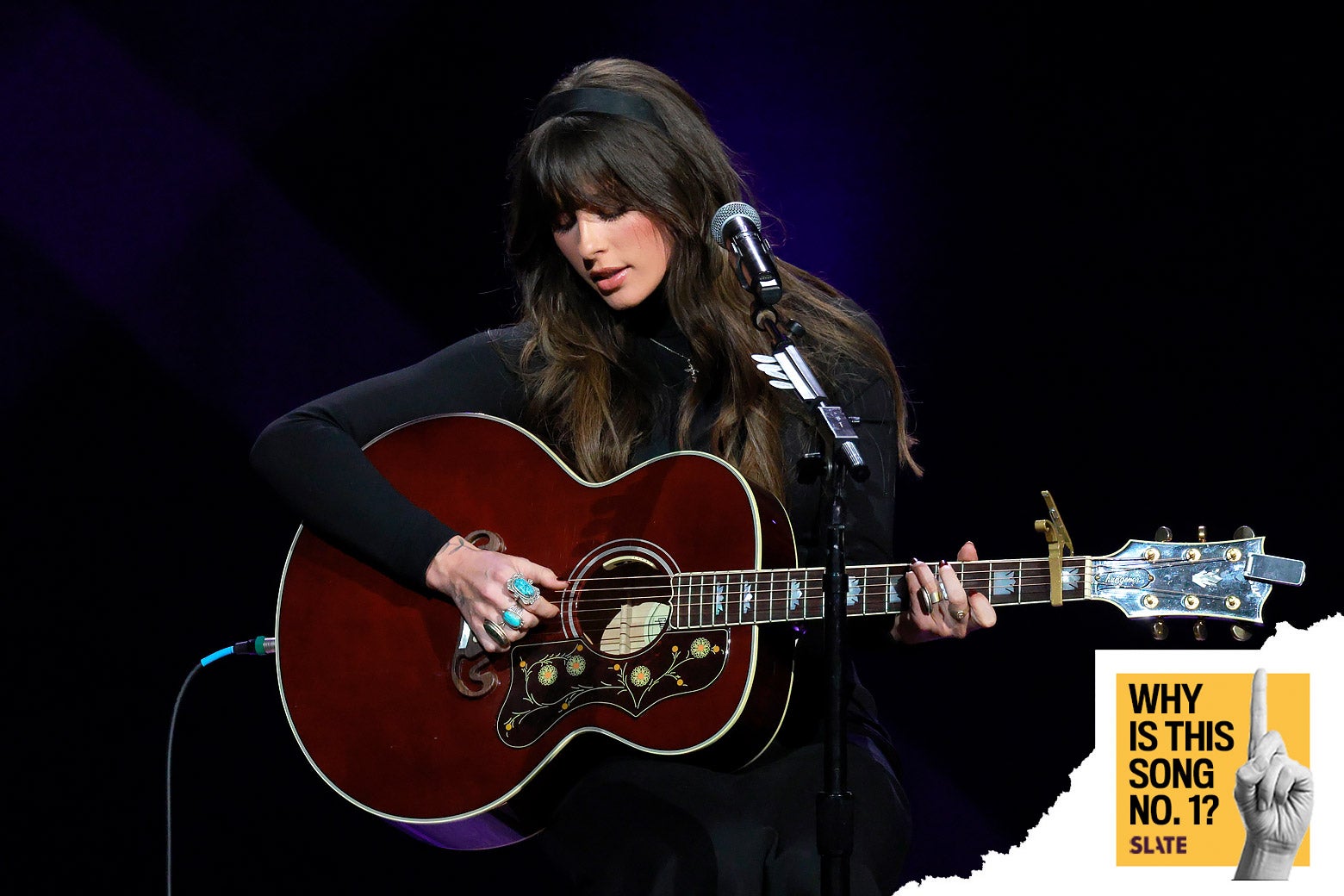
I’m walking through all this female country-pop chart history to paint a stark picture of just how exceptional and rare our current No. 1 song on the Hot 100 is. It’s by an artist, Ella Langley, who is country to the core. It’s a story-song, like “Harper Valley PTA,” but unlike Jeannie Riley, Langley is not a country newbie. She’s also not dabbling in Hollywood, like Parton in 1980, or transitioning out of country music, like Swift in 2012. Sure, Langley has recorded her share of male-female duets, like Musgraves and McRae, but her current smash, the biggest hit in her young career to date, is credited to Langley alone. And finally … I mean, just listen to the track—or heck, just look at the title. The song is called “Choosin’ Texas.” To which I say, with admiration and respect: Yeehaw.
“Choosin’ Texas” is a heartbreak song, the kind country music does best. Built out of a midtempo two-step rhythm and a sparkling steel guitar melody, the song paints a vivid tableau of a solitary woman at a honky-tonk ruing her chances at dancing with the cutest guy on the floor. Co-written by Langley herself with her mentor, country veteran Miranda Lambert, along with well-traveled songsmiths Joybeth Taylor and Luke Dick (the only dude in an otherwise all-women songwriting team), “Texas” revolves around an ingenious metaphor of home state as romantic destiny: “Just when I thought I got him to fall in love with Tennessee,” she begins, already defeated, “I should’ve known better than to take him back to Abilene / I put him right back into her arms / I wasn’t a match for that kind of spark.” It builds to a swaying singalong chorus that climaxes with a morose acceptance of her lonely fate: “Drinkin’ Jack all by myself / He’s choosin’ Texas, I can tell.”
Nothing on current pop radio sounds like this trad-country song—not even Morgan Wallen’s latest hits, suffused as they are with synths and trap beats—and yet “Choosin’ Texas” is making inroads with listeners who would never touch the country station on their radio dial. In a way, “Texas” is the purest kind of crossover hit: It’s not trying to meet pop halfway at all. It has made the leap from the Country charts to the Hot 100 without a pop remix, a special guest from another genre, a star-studded music video, or any sonic sweetening that would make the song more palatable for pop fans. Frankly—and I mean this as a compliment—it doesn’t even sound much like the 2020s. I get a strong 1980s vibe from “Choosin’ Texas,” as it channels the big-hair era of country heartbreak from the likes of Rosanne Cash, the Judds, Reba McEntire, and Kathy Mattea.
If the song seems an unlikely crossover hit, Ella Langley is the best kind of cultural emissary: using modern tools to sell old-school country. Born in Hope Hull, Alabama, Langley moved to Nashville in 2019, around age 20, to try to make it as a singer-songwriter. During the pandemic, she posted her music on TikTok, which was just starting to blow up for country acts in the post–Morgan Wallen era. Eventually, the 2022 midtempo twanger “Country Boy’s Dream Girl,” a celebration of independent-minded women who drive pickup trucks down red-dirt roads while listening to George Jones, got her signed to Sony Nashville. Her big breakthrough came more than a year later, on the cheeky “You Look Like You Love Me,” a she-said-he-said duet with witty, deliberately cornpone spoken-word verses. Langley recorded it with fellow rising country star Riley Green, and they really leaned into the kitsch. “You Look Like You Love Me” reached the Top 10 on Hot Country Songs and a remarkable No. 1 at country radio—an all-too-rare occurrence for country records with a female voice, even if it required a second male voice to get it there.
That’s when Langley started scoring hits on her own, an even more remarkable feat in a genre notorious for playing women artists rarely, and only one at a time. In the summer of 2025, Langley’s solo follow-up single “Weren’t for the Wind” reached the Top 5 on Hot Country Songs and No. 2 on Country Airplay. A second duet with Riley Green, the more earnest ballad “Don’t Mind If I Do,” kept her on DJs’ radar as it reached No. 1 in Country Airplay just before Christmas 2025. That’s when “Choosin’ Texas” started blowing up.
To understand how exceptional this song is, you have to understand how the Hot 100 works.
The big pop chart factors in airplay from all current radio formats and anybody’s streams or downloads, so if enough country listeners are consuming a song, it will appear somewhere in the middle of the big pop chart. That’s what was happening in 2024 and ’25 to Langley’s breakthrough hits, which did make modest appearances on the Hot 100—her first Riley Green duet reached No. 30 there, “Wind” reached No. 18, and the second Green duet hit No. 23. But that mostly reflected popularity with country listeners, not a great deal of pop crossover. For a country song to climb all the way into the pop Top 10, either its streams have to be massive, à la the tracks on Morgan Wallen’s past couple of albums, which blanketed the Hot 100, or the bizarre one-off No. 1 by Oliver Anthony; or pop-radio listeners must be hearing it, as happened in the summer of 2023 when Luke Combs’ cover of Tracy Chapman’s “Fast Car” rode huge cross-genre radio play to No. 2. Langley’s “Choosin’ Texas” is benefiting from both: It broke big thanks to streaming, and it’s not only scoring massive country airplay but even starting to pick up spins on Top 40 pop stations.
When “Texas” first reached No. 1 on the Hot 100 three weeks ago (it returns there this week for a second cumulative week, after a two-week interruption by Bad Bunny and Taylor Swift), Billboard reported that Langley’s hit became the first song by a woman in chart history to simultaneously top the Hot 100, Hot Country Songs, and Country Airplay. Each part of that feat is remarkable. Country songs in general only occasionally top the Hot 100 (although after mid-’20s smashes by Wallen and Shaboozey, it is becoming more common). Country songs by women only top the Hot Country Songs chart once or twice a year, if at all. And country songs by solo, unaccompanied women almost never top country radio playlists—if you’ve ever heard the portmanteau “Tomatogate,” it’s shorthand for the controversy that ensued when a country-radio DJ infamously, a decade ago, declared that women artists should be treated on country radio playlists as the tomatoes in a salad, never as its base. That’s the uphill battle women in country music are facing every day.
Which makes this week even more historic—as Langley returns to No. 1 on the Hot 100 with “Choosin’ Texas,” an album by fellow rising country star Megan Moroney, Cloud 9, debuts atop the all-genre Billboard 200 album chart. That marks the first time women in country music have topped the flagship singles and albums charts simultaneously. No seriously—like, ever: Even in the 1990s, an unusually good decade for country women, there was never a week where, say, Shania Twain was tops on the album chart while the (Dixie) Chicks were atop the Hot 100. Even in the ’00s–early ’10s country heyday of Taylor Swift, she never topped the pop album chart the same week one of her country hits topped the Hot 100.
So, yeah—what Langley and Moroney pulled off this week is pretty mind-blowing, and it’s leading to chatter in country circles and on Nashville’s famed Music Row about whether a breakthrough for female country artists is finally at hand. That’s a heavy burden to place on two ladies just emerging as country stars, and smart country-music pundits like Natalie Weiner are skeptical: “It’s still hard to be too optimistic about sweeping change in Nashville,” she writes this week for Billboard. “Beyond these two new leading lights, there’s hardly a slew of women artists on deck that have the full weight of Music Row’s marketing power behind them, in contrast to the booming middle class of male country stars responsible for the majority of hits on the Country Airplay chart.”
I share Weiner’s skepticism mixed with my own cautious optimism—and it’s the organic success of “Choosin’ Texas” that gives me some measure of hope. As I’ve been saying in this No. 1 hits series a lot in the past decade, whatever its flaws, streaming music is a great chart equalizer. It is now no longer impossible for great Christmas songs, great kiddie-soundtrack songs, great alt-pop songs, great recurrent oldies, or, finally, great country songs—including those by women—to compete effectively with pop’s regular superstars. Moreover, consider “Choosin’ Texas” itself. It’s an exceptionally good song. That core melody is an earworm, and the lyric is sharp and relatable. But it’s not fundamentally an exceptional country song in terms of instrumentation or presentation. If something as center-of-the-bullseye as “Choosin’ Texas” can top the big pop chart, it affirms that country is on a more even pop playing field than it has enjoyed since at least the 1970s.
As I often say, charts are feedback loops. Radio programmers at pop stations are now giving “Choosin’ Texas” a shot, and some country programmers are now letting a woman onto their rotations more than a couple of times a day. And now that Langley has gotten the attention of listeners who don’t normally consume country, hopefully other tracks on her forthcoming, preordained blockbuster LP Dandelion will connect—to say nothing of a generation of other women performers. I picture the mixed feelings Miranda Lambert must be having right about now—joy that a song she co-wrote and an artist she’s mentoring is crowning the Hot 100, crossed with frustration that her own classic singles, like 2010’s “The House That Built Me,” got nowhere near the top of the pops. Country was in a different place in the pop firmament in Lambert’s heyday, and the forces pushing “Choosin’ Texas” to No. 1 now are technological as much as cultural. But I hope Lambert and women across country music are taking heart that Ella Langley is doing her part to break one of music’s last glass ceilings.