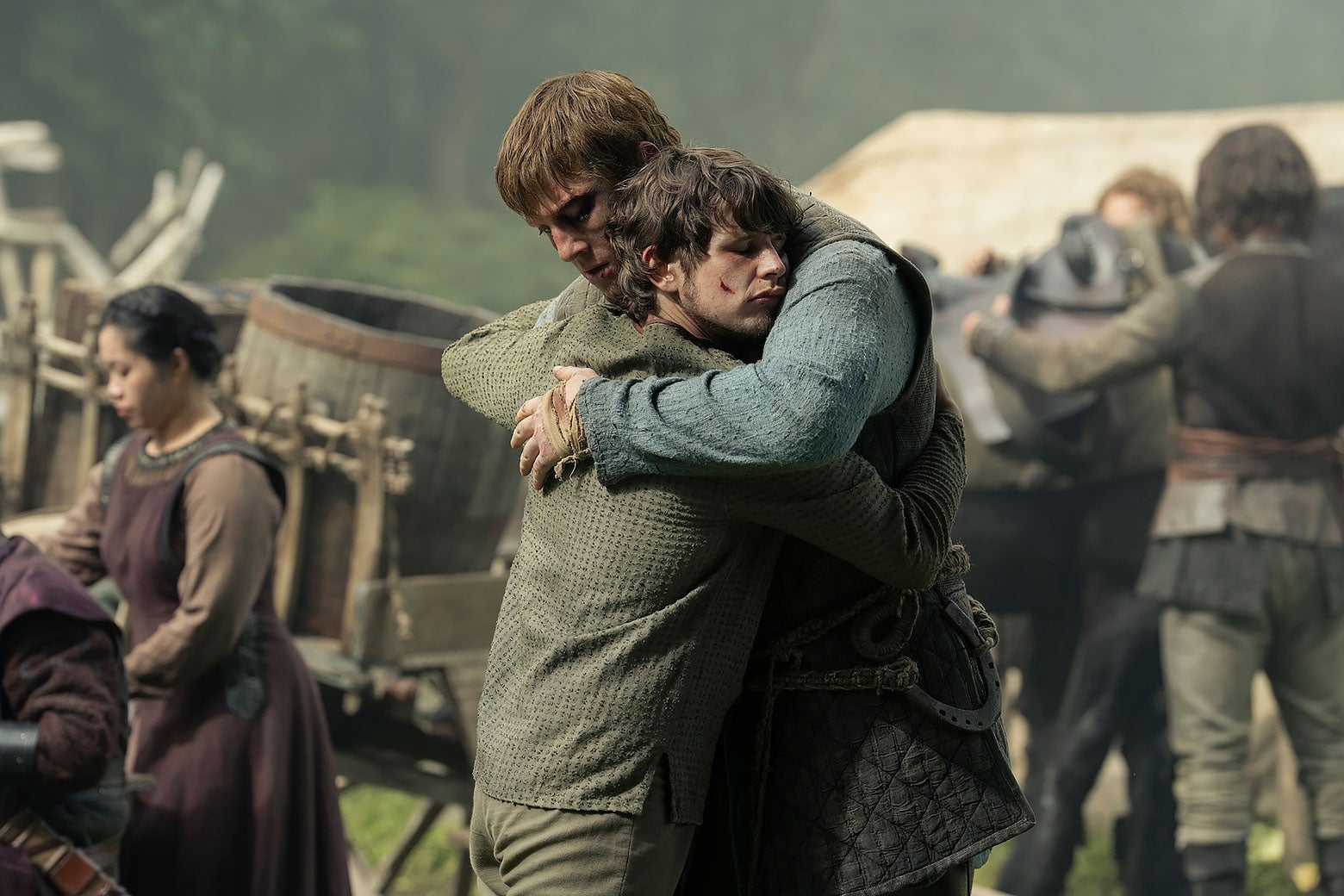
After each episode of A Knight of the Seven Kingdoms, Slate writers will gather to answer a crucial question: Who is the worst person in Westeros? This week: senior editor Jenny G. Zhang and senior editor and writer Sam Adams answer the call.
Jenny G. Zhang: As we wrap up this first season of A Knight of the Seven Kingdoms, the seriousness of the situation is impressed upon us in this sixth episode: Baelor Targaryen, the benevolent and just prince who was heir to the Iron Throne, is dead, and it’s sort of all Ser Duncan the Tall’s fault. At least, that’s how a beaten and battered Dunk feels, as he mopes about in emotional and physical agony in the aftermath of his violent trial.
I’m certain, in Dunk’s mind, he’s officially the worst person in Westeros—as I’m sure Baelor’s grieving son Valarr (Oscar Morgan) would agree. But what say you, Sam? Is there even a worst person in Westeros this week, or do we choose kindness for this final showing?
Sam Adams: Last week’s episode was a jarring change of pace, a reminder that, in a world ruled by violence, even low-stakes quarrels can have dire outcomes. Aerion’s worstness, which elevated a personal dispute into a 14-man brawl that left several—including his uncle Baelor—dead, hangs over this week’s episode as well. And, as vulnerable as I’ve been in the past to Lyonel Baratheon’s roguish charms, his callous response to Prince Baelor’s death puts him on my bad side as well. “The only good dragon is a dead dragon,” my foot. Then there’s Maekar Targaryen, the one who accidentally caved in his brother’s head with a mace. He seems to vaguely regret his incidental fratricide, but he’s not exactly outwardly mournful, and his plan to send the vile Aerion to the Free Cities for a few years to straighten him out seems more like a bid to shore up the Targaryen family brand than to actually reform the little worm. (Deep lore-knowers, at least, can be reassured that the so-called Brightflame comes to a suitably violent and painful end.) Maekar seems relatively reasonable, at least for a Targaryen, but he doesn’t appear to have any intention of honoring Baelor’s promise to make Dunk a knight in his own service.
But none of these really qualify as the worst, do they? This final episode is largely a coda in which nothing much happens, good or bad. (Whether a six-episode series should be burning half an hour wrapping up a story that’s barely begun is a question outside the scope of this chat.) So let’s turn to bests, shall we?
I started off this series by naming Dunk the Best Person in Westeros, and he’s more than proven himself by now, following through on his noble, if ill-formed, intentions with actual deeds, and muscling his way through a fight with an infinitely better-equipped foe, ultimately forcing him to yield. (Turns out Aerion was right to be afraid of him, although he didn’t have to drag 12 other guys into the mix because he had cold feet.) Dunk even turns down Maekar’s job offer because he no longer wants anything to do with princes: Once a hedge knight, always a hedge knight. Now, he’s not very nice to sweet little Egg in the process, practically reducing the sweet little baldy to tears. But Dunk has just had his face bashed in six ways to Sunday, so a little short-temperedness is understandable.
So what do you think, Jenny? Is Dunk again the best Westeros has to offer? Or can we do better still?
Zhang: It’s tempting to just give him the crown perpetually, the well-meaning lad that he is. I wouldn’t even mind granting it to him as a consolation prize, for we finally get concrete, on-screen confirmation in this episode that Dunk was never formally knighted by Ser Arlan of Pennytree, his late mentor and the man whose memory he has sought to honor this entire tournament. The knowledge that Arlan died without knighting him still stings, and is almost enough to make you just want Dunk to give in and take up Maekar’s offer to teach him how to be a real knight at Summerhall.
But let’s walk through some of the other possible “best” options here first. There was Lyonel Baratheon, who was a bit of a bastard with his bitter line about dead dragons, but on the other hand, he did offer a place at his court for Dunk, along with a promise to love him “like a brother.” (Granted, he did say that if Dunk rejected his offer, he would hate him “like a brother.” Such is the mercuriality of a Baratheon.)
Or—and this may be scraping the bottom of the barrel here—there was Prince Daeron, only the second-most disgraceful of Maekar’s sons. (Aerion is admittedly tough to beat in that arena.) Yes, Daeron is a drunkard, and a coward, and he is very much at fault for much of the mess that landed Dunk in the trial and got his uncle Baelor killed. But he also displays a touching bit of regret over the kind of people he and Aerion have become, telling Dunk that Aerion was once a “glad child”—the suggestion being that, while it may be too late for the two elder brothers, it’s not yet too late for Egg to turn out decent, if only Dunk will provide him the right kind of nurture.
What say you, Sam? Are either of these enough to grant one of these flawed scallywags the honor of being BPiW?
Adams: What I like about A Knight of the Seven Kingdoms is its overall lack of import. This is, as we’re reminded along the way, a show that takes place in peacetime, or at least as close to it as Westeros gets. (There hasn’t even been a Trial of the Seven in a century.) There’s no massive civil war in the offing, let alone an existential battle for the fate of humanity, so the things people do, both good and bad, tend to be relatively inconsequential, at least in world-historical terms.
In other words, I think you’re right to focus on the small here. This isn’t a moment for epic heroism but of modest deeds, which might make Dunk, like the Dude, just the right man for his time and place. Lyonel’s got his good side, and he’s not wrong about the Targaryens as a whole, which is why I can extend at least a little bit of sympathy to Daeron, even if he is a spineless weasel who got several people killed because he didn’t want to admit to losing track of his cousin. Egg has his upside, too (and yes, that’s a pun I’ve waited six whole weeks to make).
But I think we’re overlooking the most truehearted character of all. I speak, of course, of Raymun Fossoway. Westeros’ newest knight has been a minor character in this story, but a steadfast one, sticking by Dunk’s side even when his cousin Steffon turned traitor. (In my headcanon, at least, the lordship Steffon was promised for taking up arms against Dunk never materialized.) And if that weren’t enough, there’s Sweetfoot. Buying back Ser Arlan’s horse and gifting it to Dunk may be the purest act of kindness in the entire Game of Thrones universe. And, while it’s not the kind of grand gesture that’s likely to be immortalized in song or woven into a tapestry, I think we can at least do our part to commemorate Raymun’s generosity by naming him the Best Person in Westeros—not just this week, but possibly ever.
Jenny: Can I get a “gods be good”?
Zhang: Seven hells, you’ve done it: You’ve landed upon the clear Best in this week’s competition. Even if the bards never do, let us honor the superior Fossoway as Ser Raymun the Pal, Raymun the Romantic, Raymun the New Owner of a Wonderful Mare. Even though Dunk turns around and gives Sweetfoot right back to his friend (I guess regifting isn’t so frowned upon in Westeros), the gesture and the intent were there, and they were beautiful.
Thus concludes Slate’s recurring feature Worst (or Best) Person in Westeros for this season of A Knight of the Seven Kingdoms. I’m sure next season will bring plenty of fresh candidates to work with, considering the juicy conflict promised in the final moments of this episode. Until next time—gods be good, indeed!