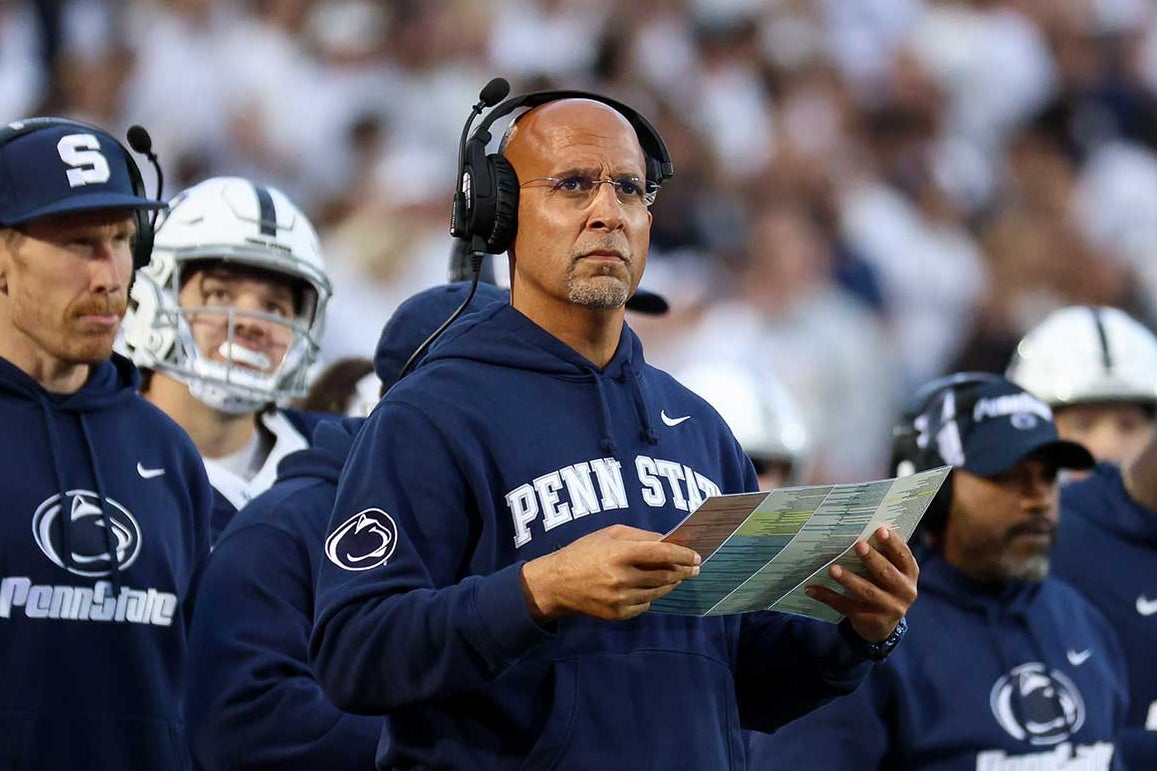
Sixteen days ago, Penn State was the center of the college football universe. Now it’s a smoldering crater whose warlords have agreed to pay what could be (but probably won’t wind up being) a $50 million buyout for the coach to go away. But we must give the Nittany Lions this: They had to do it—and that’s the worst indictment of the state of college football.
Penn State was ranked No. 3 in the country on Sept. 27, when it hosted No. 6 Oregon. It was the biggest game of the season, and 111,000 people packed into Beaver Stadium, nearly all of them in white shirts. College GameDay, the flagship ESPN show, had aired live from State College that morning. In overtime, quarterback Drew Allar threw a game-ending interception, which turned out to functionally be an era-ending interception. The next weekend, Penn State went to Pasadena, a trip the team treated as a vacation, as evidenced by the Lions’ loss to a winless UCLA team that had already fired its coach. Even more unthinkable was a home loss to Northwestern on Saturday, making Penn State the first team to lose as a 20-point favorite or more in back-to-back weeks. Ergo, coach James Franklin is fired.
Franklin is one of the better coaches in college football, all things considered. But the past few weeks have been such a specific disaster that his run at Penn State had to be over. At the highest level, this has become a sport in which there is no possibility of reducing a fan revolt against a coach to “noise,” as Franklin labeled it at his final press conference, right before he was fired. When everyone in a program’s orbit is a piggy bank that needs to be tapped at all times for the program to remain competitive, the noise is the signal.
The defining emotional characteristic of modern college football is paranoia. That paranoia is why Franklin got a 10-year, $85 million contract extension, including what amounted to his much-discussed $50 million buyout in 2021, a year in which Penn State flopped and went 7–6. Penn State wasn’t playing well, but Franklin had recruited a good roster, and the idea of some other school paying Franklin was unpalatable. What an ego hit that would be for a prestige program to lose a sitting head coach—and what uncertainty it would bring. So Penn State’s athletic director Sandy Barbour, who retired well before having to deal with the consequences, gave the coach the megacontract.
Franklin’s firing shows how administrators’ constant terror of not competing at the highest level tends to line coaches’ pockets on the way in and the way out. Penn State probably will not actually have to pay him $50 million. The details of his contract are not public, because Pennsylvania has very bad records-disclosure requirements for its state universities. Front Office Sports reports that Franklin’s contract contains language that requires him to look for another job, and that his wages in that job would count against what Penn State owes him. That could massively cut into the compensation. At a press conference on Monday, the school’s athletic director would say nothing other than that the athletic department, rather than the main campus, would handle the payments, which are due in installments over several years. But the point remains that Franklin is going to get at least one Brink’s truck’s worth of cash from Penn State because the school decided that keeping him was a worse option than handing over whatever amount of money he will get.
And it might be right about that. Just using quick napkin math, Penn State sold $44 million in football tickets last year, according to its financial filing with the NCAA. It pulled in another $37 million in fundraising contributions, which do not include untold millions more in donations to third-party groups that collaborate with the athletic department to get football players paid at competitive rates. (Penn State spent several years getting its house in order for outside donors to compensate the players.) Say the school does have to pay Franklin $8 million a year through 2031, when his contract would have run out. Penn State probably wouldn’t see an $8 million decline in ticket sales if it kept Franklin around, but could major donors get mad enough to withhold donations or send less? Certainly. And if just a few contributors pulled back on donations to the player-payment kitty, and the football team went into the tank on a more permanent basis, the potential financial losses would be hard to calculate. You can see how the athletic department could reason its way to swallowing an eye-watering buyout of the coach. It’s the same reason Ohio State may well have canned its coach had it bowed out early from last year’s College Football Playoff. Fortunately for all parties, Ryan Day simplified the situation by winning the championship instead. Certain depths of toxicity are impossible to come back from, and while the Buckeyes didn’t reach them, Penn State did.
This is, of course, gross. Administrators massage the practice of making eight-figure termination payments by pointing out (as Penn State’s AD did) that buyout money comes from the athletic budget, not the general university budget. That’s true, and athletic departments at Penn State’s level are financially self-sufficient. But nobody would give half a shit about Penn State football if it were not attached to Pennsylvania State University, a crown jewel propped up for the better part of two centuries by both Pennsylvania taxpayers and federal grants. Hundreds of thousands of people don’t go to Happy Valley on Saturdays in the fall to root for some semipro team that just happens to be based in Central Pennsylvania. Penn State football—just like Ohio State, Michigan, Texas, Florida, or Oregon football—benefits from a million invisible public subsidies every time it plays a game. (The stadium’s on a college campus! People have to park somewhere! More fundamentally, the brand power of the program is tied to the brand power of the public university!) I don’t think it makes you an annoying wokescold to expect better stewardship of these programs. And it’s especially galling while administrators cry poor before Congress, hoping for antitrust help in managing college sports.
In that way, Franklin’s firing is a macro story about the whole industry. But, admittedly, the most interesting thing about his ouster is how his own management of Penn State built up to it so perfectly. Franklin was a great program-builder at Penn State, adept at recruiting good players and developing them into stars over time. He was good enough to get the Nittany Lions into a ton of big games, and that’s half the job. Unfortunately, the other half is winning them, and Franklin fell on his face in that area. Franklin went 1–18 in regular season games against Big Ten opponents ranked in the top 10, his only victory coming in 2016. Penn State was so much better than almost every opponent but so much worse than the ones that mattered most, usually Ohio State and Michigan. He never did develop a star quarterback who could get him over the hump, and when his QBs were enough, something else went wrong. For a long time, Franklin could at least say that Penn State was right there. Losing to UCLA and Northwestern undercut that argument and led to a firing that nobody could’ve seen coming three weeks ago.
So ends a tenure that began in 2014, only a few years after the legendary Joe Paterno lost his job in historic disgrace. A significant faction of Penn State fans and power brokers remains loyal to Paterno, who they feel was treated unfairly after the world learned that he had not only had a child molester on his staff for decades but had gotten at least an inkling of his subordinate’s criminality and not gone to law enforcement. One of Paterno’s sons is still on Penn State’s board of trustees and was being shopped around to reporters to comment on Franklin’s firing this week. Franklin’s predecessor left the job in part because “the Paterno people” were so insufferable. Franklin provided stability, giving the program a normal leader who didn’t seem preoccupied with appeasing the school’s most annoying old guard members. As longtime Penn State writer Ben Jones wrote this week, Franklin was concerned with coaching football and not with becoming some kind of community institution. His lack of concern with winning hearts and minds may have hastened his demise once things got bad. But it served Penn State well, until a different kind of local politics—the need to always get more money out of people—did him in.