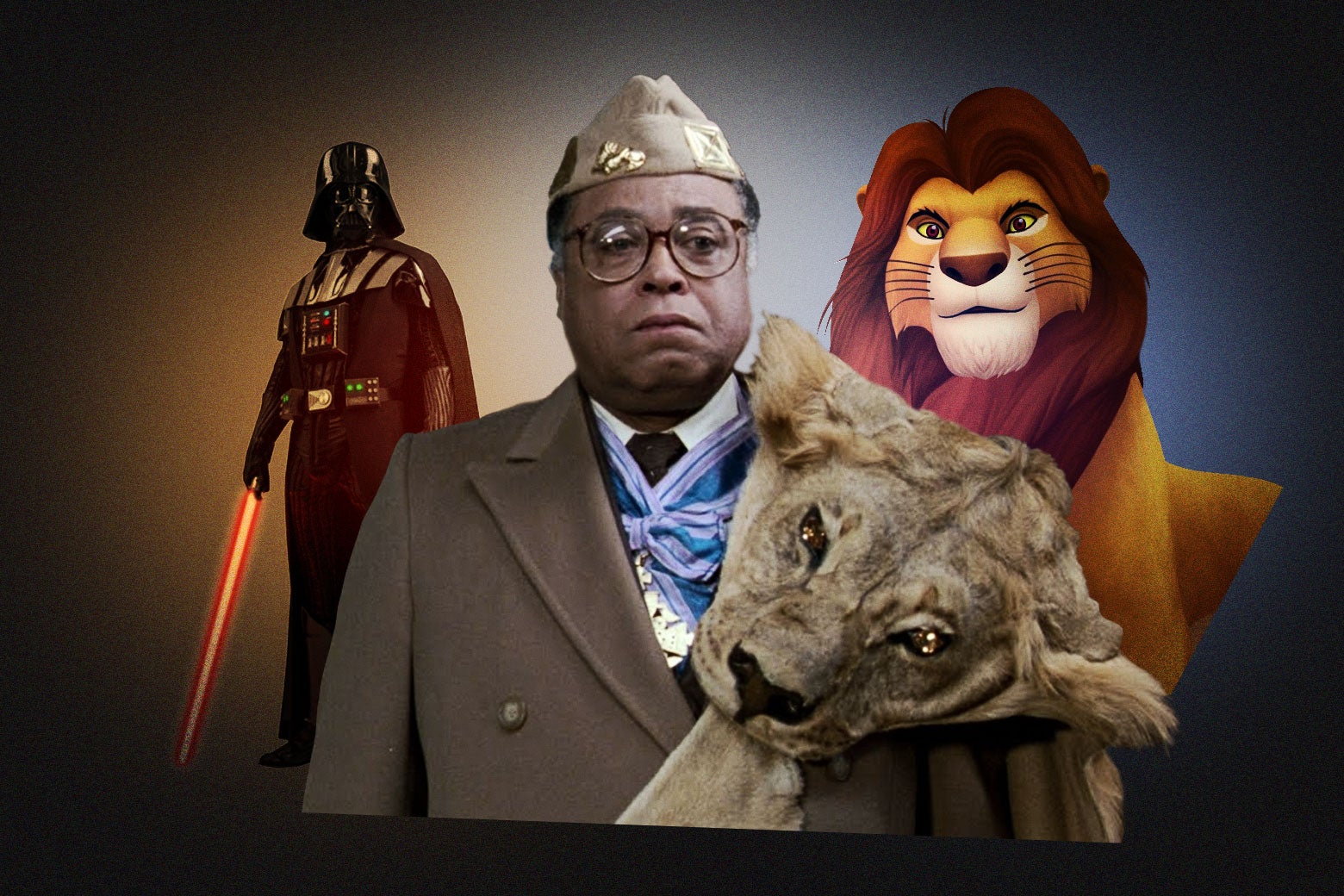
In my memory, the first voice I ever heard on-screen was that of James Earl Jones—Coming to America, my mother’s favorite movie, played often in our home; I’ve witnessed her quoting every line even with the television’s sound muted. I have to believe Jones’ voice is the same timbre as the first note in existence: booming, rich, resolute. I imagine entering the world immediately knowing life can be as magical, as certain, as full as he makes it sound.
On Monday, the news broke that Jones had died at the age of 93, at his home in upstate New York, with nearly seven decades of work on the stage and screen behind him. It isn’t simply longevity that marks Jones’ legacy as one of the most distinguished and protean actors in history—it’s the way in which Jones cemented himself as a legendary figure for multiple consecutive generations. If you didn’t know him as a leading Shakespearean actor in the 1960s, you would know him from his work in the ’70s—perhaps from his Oscar-nominated role as a heavyweight boxing champion fighting prejudice in 1970’s The Great White Hope, or for his scene-stealing vocal performance as Star Wars’ Darth Vader, one of the most recognizable characters in cinematic history. If you were born later, you might remember Jones more formatively as the King of Zamunda in Eddie Murphy’s 1988 hit comedy Coming to America, or as the well-spoken novelist Terence Mann in 1989’s baseball tearjerker Field of Dreams. (Click any one of those links: These renderings are so indelible that, already, fans are gathering on YouTube, in the comments beneath these well-known scenes, to reminisce and thank Jones for what he has given us.)
But Jones’ sphere of influence didn’t conclude there; his talent simply never knew the meaning of the word “end.” My generation was first introduced to Jones with his voice-acting work as Mufasa in Disney’s iconic 1994 animated children’s film The Lion King—a movie that simultaneously delighted and traumatized an entire age group as it brought us not only Disney’s best soundtrack for an animated film, but also one of the first and most visceral main-character deaths we would experience. Many of us will never forget watching Mufasa fall into that gorge amid a wildebeest stampede, the same voice that had just reassured us that we own the world now desperate and pleading in the face of mortality.
There are a swath of other influential Jones roles—big Hollywood titles such as The Hunt for Red October, The Sandlot, and Clear and Present Danger just scratch the surface of his résumé in the ’90s—but what stands out about his work is not simply that he was always there, but the specific way in which he performed magic for the camera. With his instantly identifiable speech, he often appeared as a father figure, alternately authoritative, kind, dominant, and supportive. In 1974’s Claudine, Jones starred opposite Diahann Carroll as a poor man who falls in love with a single mother of six, and enters the family as both a new father figure and a struggling breadwinner. Whether he’s the regal, demanding father doling out ultimatums to his hopelessly romantic African prince of a son, the wise feline patriarch who falls victim to his own brother’s betrayal, or the famously absent father lost to the dark side of the Force, Jones has been our on-screen parent for decades.
Importantly, for many of us, Jones didn’t just exemplify the father, but more specifically, the Black father. He reached the top of the mountain, after an uphill climb to become one of the most pioneering Black actors in history. Not only was he able to explore racism and discrimination through his work in films and stage plays like the Broadway debut of August Wilson’s Fences, but he broke barriers by eking out what recognition he could for them. Jones never won a competitive Oscar, though he received an Academy Honorary Award in 2011 for his lifetime achievements. His first Oscar nomination, for his performance as Jack Johnson in The Great White Hope, made him only the second Black man to be nominated for Best Actor after Sidney Poitier.
There’s no possibility of downplaying his integral role in giving Black people, particularly Black men, myriad ways to see themselves reflected on screens big and small, in stories as sprawling as space operas or as local as the coal mining town of Matewan, West Virginia. But his legacy can also be subtly felt, like the effects of a boulder thrown into a river of Black artisanry, rippling outward for more than 60 years. Sterling K. Brown would not be effortlessly reciting a sonnet over ridiculously hot wings in today’s zany media landscape if it weren’t for Jones. Jeffrey Wright’s performance in last year’s Oscar-winning film American Fiction at times feels particularly inspired by the prodigious actor. Denzel Washington practically walked in the same Hollywood footprints Jones left, trailing behind him to get to where he is now—from Shakespeare on stage and screen to even reprising some of Jones’ landmark roles, as in Fences.
Jones’ legacy will outlive us all. But what I’ll remember most is his signature voice: the voice that has reprimanded us, defended us, taught us, and reared us. With nearly 90 television series and, as the New York Times summates, “some 120 movies,” Jones’ rounded baritone—hard-won, after he reportedly overcame a severe stutter as a child—carried so many viewers through eras of ruminations on fatherhood and life. I envision generations remembering the man with a name you can’t help but say in full. In the few hours we see him plant seeds as someone else, I am free to dream up entire forests. I see myself showing The Lion King to my children, and teaching them of losing a father. When I catch strands of that definitive voice ringing from the television in a Black family’s living room, I’ll think to myself: That is my father, my brother, my friend. That voice is the first voice I ever heard.